
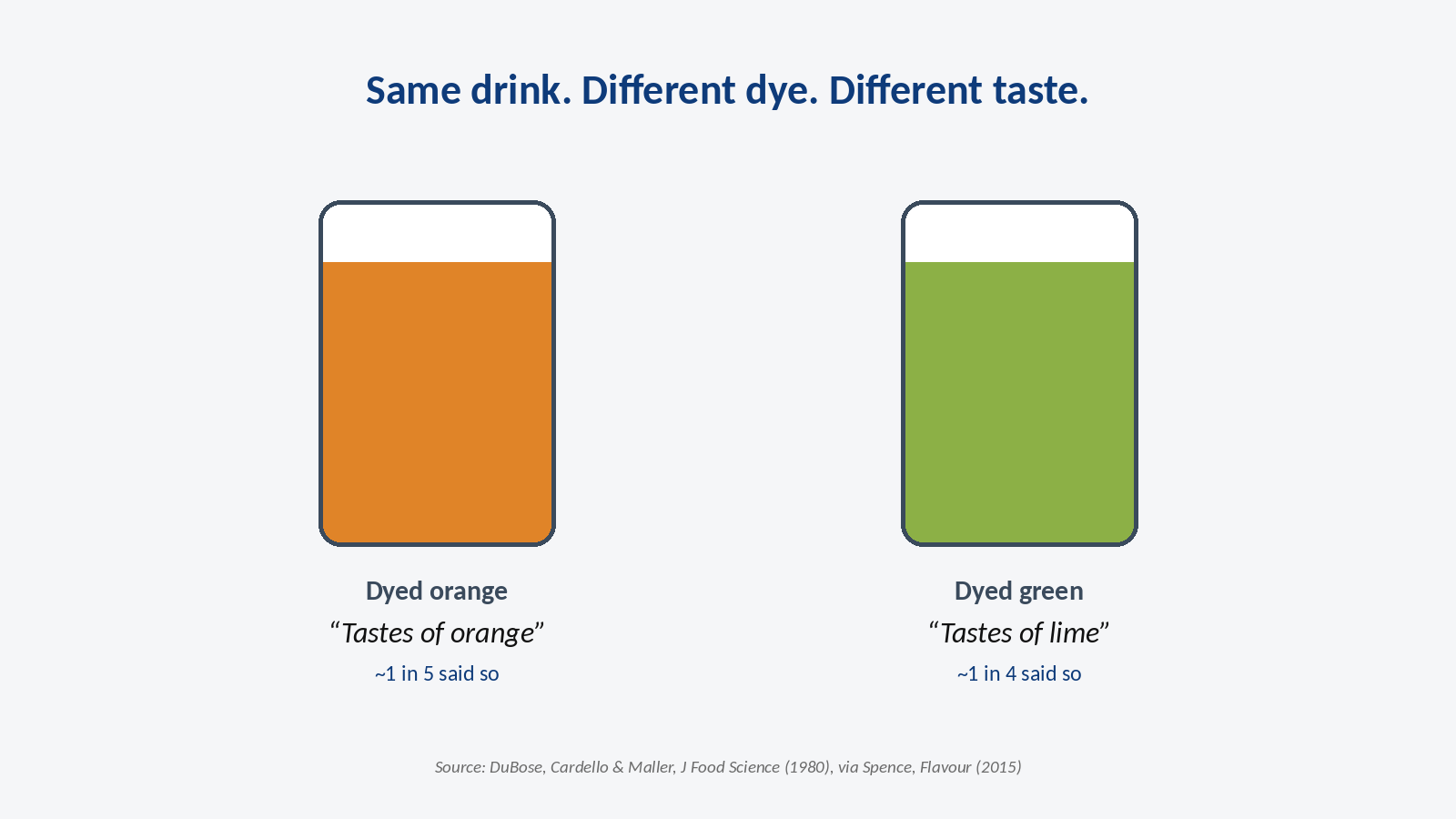
Dye a cherry-flavoured drink orange, and something like one in five people will say, quite confidently, that it tastes of orange. Dye the same drink green, and about a quarter will call it lime. Nothing in the liquid changes. Only the dye does.
The tongue hasn’t been fooled, exactly — it hasn’t been given the chance to decide. The eye tastes first, and more often than we’d like to admit, the tongue simply agrees.
The Grammar of Colour
That 1980 finding is one data point in a much larger pattern. Across decades of taste research, colour and flavour turn out to be cross-wired in perception, and the wiring is remarkably consistent from one person to the next.
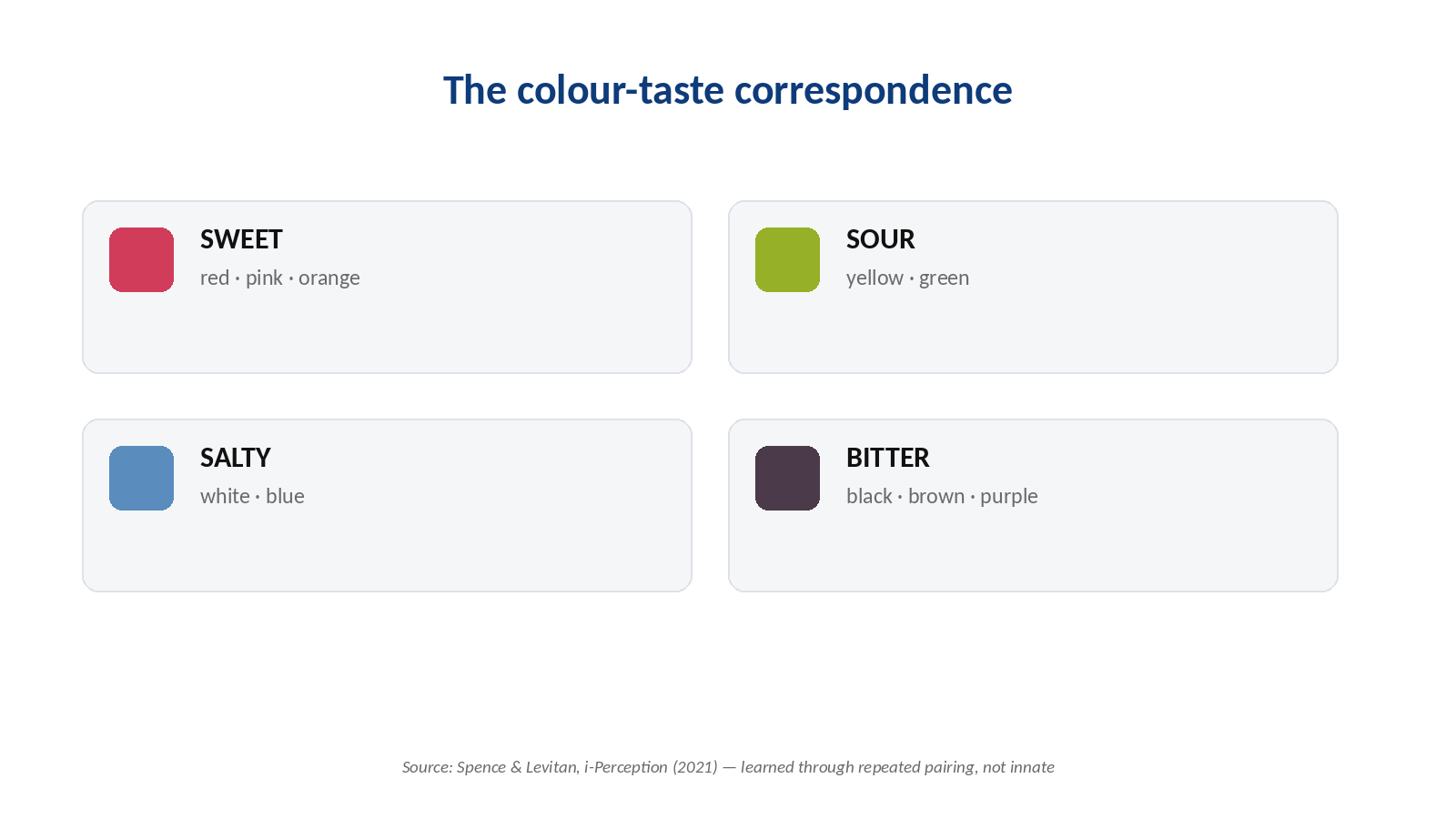
Red, pink and orange read as sweet. Yellow and green read as sour. White and blue read as salty. Black, brown and purple read as bitter. It behaves like a grammar — rules the brain applies to a colour well before any chemistry is involved.
It isn’t the only place colour does this kind of work in medicine. Pill colour and even price change how effective a treatment is perceived to be, for reasons that have nothing to do with the active ingredient — the subject of a companion piece, The Aesthetics of Trust.
Learned, Not Wired
It would be easy to mistake this for synaesthesia, some hard-wired crossing of the senses. It isn’t. Researchers describe it as the internalisation of crossmodal statistics: a lifetime spent noticing which colours tend to arrive with which flavours, until the pairing hardens into an expectation, and the expectation becomes almost indistinguishable from perception itself.
Nobody is born expecting red to taste sweet. Everybody learns it, one strawberry and one glass of squash at a time.
The Syrup’s Second Job
Children’s medicine sits directly inside this mechanism. A paediatric syrup that is sweetened and brightly coloured isn’t only delivering an active ingredient — it’s pre-signalling, before the first taste, that the dose is going to be fine. The eye tastes first here too, and a child who trusts what they see is more likely to swallow what they’re given.
Colour, in this context, is not cosmetic. It is part of the delivery mechanism, doing perceptual work no amount of chemistry alone can do — and, for a syrup that has to be measured, poured and finished to the last millilitre, that work matters every single dose, not just the first one.
What Colour Costs
It would be reasonable to call this decoration — pleasant, but clinically inert. EU regulators disagree.
Six azo dyes, tartrazine and sunset yellow among them, are used across the industry to achieve exactly this visual cue in oral liquid medicines. All six carry a mandatory label warning: may cause allergic reactions. There is no safe threshold — any amount, in a sensitive patient, can trigger it.
So the formulator’s decision is rarely simple. Colour the syrup, and the flavour reads as intended, but take on a labelling obligation and a small population of patients for whom that colour is a real risk. Leave it colourless, and the flavour may read as wrong before it is even tasted — at exactly the moment a parent needs a full dose taken, not half of one poured away because a child didn’t trust the look of it.
The Same Logic, a Different Aisle
Walk past the toothpaste into the mouthwash aisle and the same convention is at work. Blue and green bottles read as cool and minty before the cap is off. No one has run this exact study on mouthwash — they didn’t need to. It is the same correspondence, one aisle over.
Why This Matters to Formulation
For a company built on liquid formulation, this is not a footnote. A dose is not only a quantity of active ingredient; it is a colour, a viscosity, a taste, arriving together in one spoonful. Get the chemistry right and ignore what that spoonful signals before it is tasted, and only half the brief has been solved. The other half was decided by the eye, before the tongue was even consulted.
What The Eye Has Already Decided
By the time a liquid medicine reaches a tongue, the eye has already done a great deal of the work — deciding what the spoonful is about to taste like, long before it does.
The eye tastes first. It always will. The only real choice left to a formulator is whether that first taste is decided on purpose, or left to whatever colour happened to be in the tank.
Sources
- DuBose CN, Cardello AV, Maller O (1980). Effects of Colorants and Flavorants on Identification, Perceived Flavor Intensity, and Hedonic Quality of Fruit-Flavored Beverages and Cake. Journal of Food Science 45(5):1393–1399. https://doi.org/10.1111/j.1365-2621.1980.tb06562.x
- Spence C (2015). On the psychological impact of food colour. Flavour 4:21. https://doi.org/10.1186/s13411-015-0031-3
- Spence C, Levitan CA (2021). Explaining Crossmodal Correspondences Between Colours and Tastes. i-Perception 12(6). https://doi.org/10.1177/20416695211018223
- EMA/CHMP (2019). Annex to the European Commission guideline on ‘Excipients in the labelling and package leaflet of medicinal products for human use’ (SANTE/2017/11668 Rev.2). ema.europa.eu