
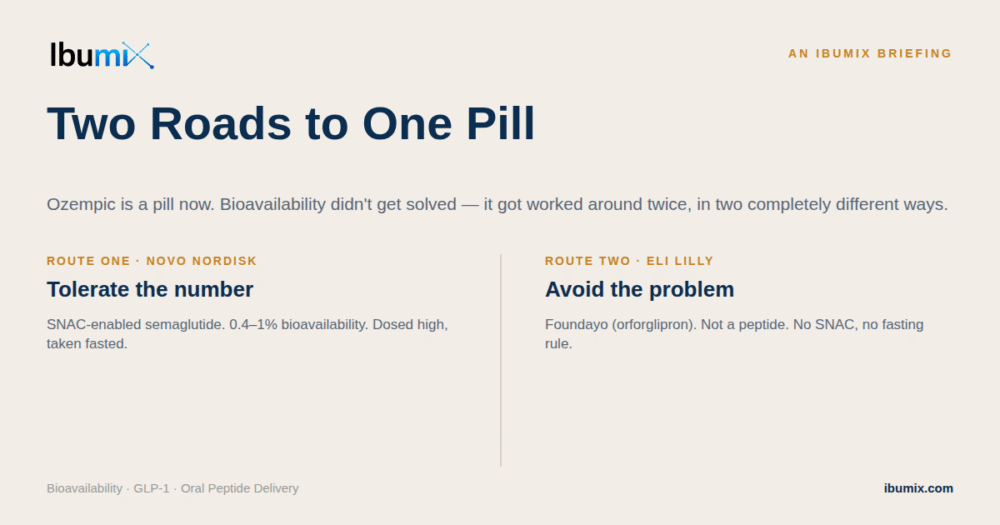
Ozempic is a pill now. Bioavailability didn’t get solved — it got worked around twice, in two completely different ways, within the same five months.
BY GEORGE FORREST · 12 AUGUST 2026 · TECHNOLOGY
By Ibumix · 6-minute read
On 4 May 2026, a box of tablets went on sale in US pharmacies under a brand name that, for eighteen years, had only ever meant an injection [1]. Ozempic — the name, not just the molecule — became something you swallow.
It’s tempting to read that as the moment oral peptide bioavailability finally got solved. It wasn’t. Absolute oral bioavailability for a peptide taken as a simple tablet has sat at roughly 1% or less for as long as insulin has existed in injectable form [9][10]. What changed in the five months before Ozempic became a pill is that a different company, working on the same target, decided not to solve that number at all.
Route one: tolerate the number
Novo Nordisk’s route starts with SNAC, an absorption-enhancing excipient co-formulated with semaglutide since Rybelsus first reached the US market in 2019 [9]. SNAC creates a temporary, localised change in stomach chemistry around the tablet, letting a fraction more of the peptide survive intact into the gut wall. It is a genuine pharmaceutical innovation — and it still leaves oral semaglutide’s absolute bioavailability at roughly 0.4–1%, essentially unchanged across every dose and every brand it is sold under [9][10].
Novo’s answer to that ceiling has never been to raise it. It has been to dose around it. The 25mg Wegovy tablet approved for weight loss on 22 December 2025 carries roughly ten times the peptide of the 2.4mg weekly injectable it is meant to replace — taken daily rather than weekly — because so little of each dose is actually absorbed [2][3]. The label reflects the same trade-off: take the tablet whole, on an empty stomach, after fasting at least eight hours, and wait a further 30 minutes before food, drink or any other medicine, because eating too soon lowers absorption further still [8].
What that costs, exactly
That fasting rule is not a minor inconvenience folded into the small print. It is the visible cost of tolerating a bioavailability problem at population scale. Every patient on the tablet repeats the same routine every day: wake, take the tablet with no more than a sip of water, wait. Miss the window and the dose is likely to underperform. Novo’s own trial data shows the discipline matters — OASIS 4 patients who took the tablet exactly as directed lost an average of 16.6% of their body weight over 64 weeks; patients counted regardless of whether they stayed on treatment lost 13.6% [3][4]. The gap between those two numbers is, in effect, the price of the fasting rule.
Route two: refuse to have the problem
Eli Lilly’s answer, approved for obesity on 1 April 2026, does not try to out-engineer semaglutide’s bioavailability at all. Foundayo (orforglipron) is not a peptide. It is a small molecule, built from the first design decision to be absorbed the way ordinary tablets are absorbed — no SNAC, no co-formulated enhancer, and no fasting instruction [5][6]. There is no bioavailability cliff to manage, because there is no peptide backbone for stomach acid and digestive enzymes to destroy in the first place.
The approval itself was almost as unusual as the chemistry. Foundayo was cleared under the FDA’s new Commissioner’s National Priority Voucher pilot programme, 50 days after filing and 294 days ahead of its scheduled review date — the fastest approval of a new molecular entity since 2002 [5][7].
Same finish line
On the measure Novo led with for its own tablet — weight loss among patients who stayed on treatment — Foundayo’s pivotal ATTAIN-1 trial reported 12.4% weight loss against 0.9% for placebo [6]. Counted the more conservative way, including everyone who started the drug whether or not they finished the course, the figure was 11.1% against 2.1% for placebo [6]. Against Wegovy’s 16.6% and 13.6% on the same two measures, the two drugs land within a few points of each other — arrived at by refusing to make the same trade-off.
What this actually settles
Read as a verdict on bioavailability, the last five months settle nothing. The number that has kept most peptide drugs injectable for a century — call it 1%, call it roughly none of it gets through — has not moved. What has changed is that two companies have now shown, independently and at commercial scale, that a low number does not have to be a dead end. One raised the dose and built a ritual around it. The other picked a molecule the ritual was never going to apply to.
There is a third strategy neither company took, and it is the one still unproven in a person: instead of raising the dose or changing the molecule, change what the drug travels in. Wrap a peptide in a lipid particle before it ever meets stomach acid, so it arrives at the gut wall already disguised as something the body already knows how to absorb, rather than negotiating passage through a modified stomach or a loosened gut wall. The best published number for that approach, from a 2020 mouse study, beat Rybelsus’s ceiling by more than five times — and, as the third instalment of this series covered, nobody has tried it in a person yet.
Which bet ages better?
Ozempic is a pill now. The molecule that used to need a needle can be swallowed — but swallow the tablet and you are still asked to do it fasted, on an empty stomach, exactly as if the underlying number had never moved, because it has not. Five weeks earlier, a different company shipped a comparable result without asking anyone to fast at all, by declining to use a peptide at all.
Neither company solved bioavailability. They just decided, separately, that they did not have to. The more interesting question is not which of the two pills wins. It is which bet — dose around the ceiling, or design below it — ages better once a third route, still unproven, finally gets its turn in a person.
Ibumix is developing a series of new liquid drug delivery platforms built on glyceryl caprate (GCC) lipid chemistry, with a patent estate covering the underlying formulation and device.
This piece sits alongside Ibumix’s ongoing series on why oral peptide delivery is hard: The Three Battles Every Oral Peptide Must Win, The First Battle, Won, The Second Battle, Opened From the Inside, and The Third Battle, Better on Paper. For the underlying problem in full, see the pillar page, Bioavailability: the medicine that never arrives.
BIOAVAILABILITY · GLP-1 · ORAL PEPTIDE DELIVERY · SEMAGLUTIDE · ORFORGLIPRON · DRUG DELIVERY · FORMULATION SCIENCE
Sources
1. Novo Nordisk. Novo Nordisk’s Ozempic® Pill, the Only FDA-Approved Oral Peptide GLP-1 Medication for Adults With Type 2 Diabetes, Soon to Be Available in the US. Press release, 1 May 2026. prnewswire.com
2. Novo Nordisk. FDA Approves Novo Nordisk’s Wegovy® Pill, the First and Only Oral GLP-1 for Weight Loss in Adults. Press release, 22 December 2025. prnewswire.com
3. Novo Nordisk. Wegovy® Pill FDA Approval — Company Announcement. 22 December 2025. novonordisk.com
4. Applied Clinical Trials Online. FDA Approves Oral Wegovy Following Positive Phase III OASIS 4 Trial Results. appliedclinicaltrialsonline.com
5. U.S. Food and Drug Administration. FDA Approves First New Molecular Entity Under National Priority Voucher Program. Press announcement, 1 April 2026. fda.gov
6. Eli Lilly and Company. FDA Approves Lilly’s Foundayo™ (orforglipron), the Only GLP-1 Pill. Investor release, 1 April 2026. investor.lilly.com
7. STAT News. Eli Lilly’s Obesity Pill Approved: Orforglipron / Foundayo. 1 April 2026. statnews.com
8. Pharmaceutical Journal. MHRA Approves Semaglutide Oral Tablets for Weight Loss. 11 June 2026. pharmaceutical-journal.com
9. American Diabetes Association, Clinical Diabetes. Current Understanding of SNAC as an Absorption Enhancer: The Oral Semaglutide Experience. DOI: 10.2337/cd22-0118. pmc.ncbi.nlm.nih.gov
10. RYBELSUS (semaglutide) Full Prescribing Information — estimated absolute bioavailability of 0.4–1%. FDA label. accessdata.fda.gov