
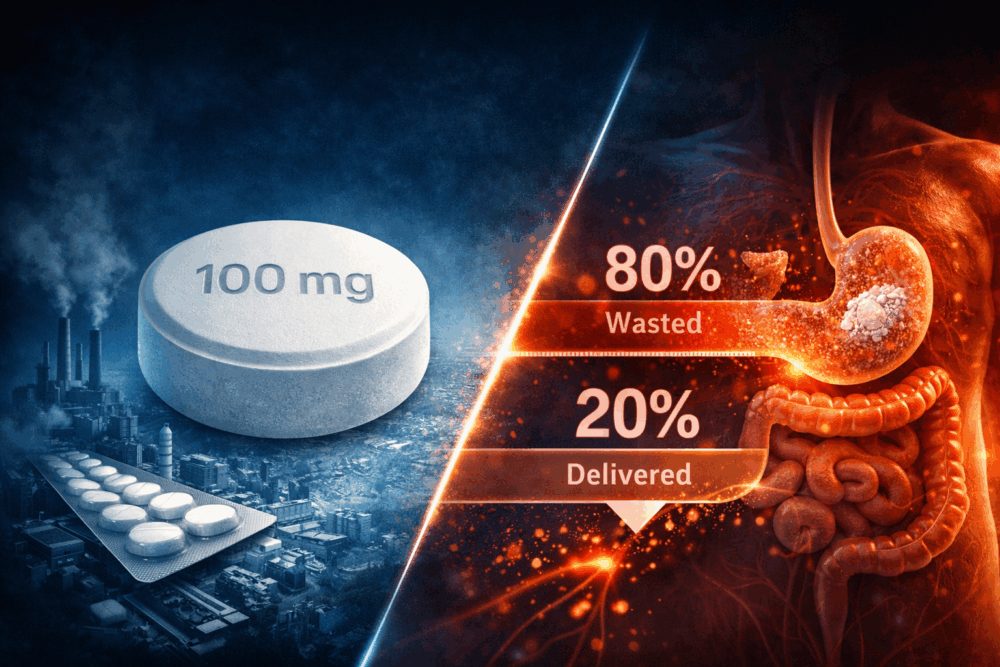
The Illusion of Effectiveness
The single number that decides whether a medicine works. The one number patients are never told.
(7-minute read)
The Assumption
Modern medicine rests on a quiet, unquestioned belief.
If you swallow 100 mg, your body receives 100 mg.
It feels precise. Scientific. Engineered.
It is none of those things.
The Number You Are Never Told
A tablet labelled 100 mg does not deliver 100 mg.
It might deliver 70. Or 40. Or 10. Sometimes far less.
Consider the molecules sitting in millions of medicine cabinets right now:
- Atorvastatin, the world’s best-selling drug for over a decade — about 14% reaches systemic circulation.
- Propranolol, on every cardiology formulary on earth — about 25%, with patient-to-patient variation between 10% and 30%.
- Cyclosporine, the immunosuppressant that made modern transplantation possible — bioavailability that ranges from 5% to nearly 90% between individuals on the same dose.
- Oral semaglutide (Rybelsus), the most consequential GLP-1 launch of the decade — absolute bioavailability of 0.4–1%, on the FDA label.
That last one is not a typo.
The drug pharma is most excited about right now reaches the bloodstream at roughly one part per hundred. The other ninety-nine never arrive.
This is not edge-case variability. This is bioavailability — the percentage of a drug that actually reaches systemic circulation. And critically:
You are never told which percentage applies to you.
Read this slowly:
A 100 mg tablet that delivers 30 mg is not a 100 mg medicine. It is a 30 mg medicine pretending to be precise.
Everything else is packaging.
Where the Drug Disappears
Between swallowing and effect, every oral drug must survive a sequence of losses:
- Disintegration — the tablet must break apart at the right place, at the right speed.
- Dissolution — the drug must become soluble in gastric or intestinal fluid.
- Degradation — stomach acid destroys a fraction.
- Absorption — only part crosses the gut wall.
- First-pass metabolism — the liver removes more before the drug ever reaches its target.
At each step, quantity is reduced. At each step, variability is introduced.
This pathway exists not because it is optimal — but because it is compatible with how we manufacture tablets.
The Illusion
Medicine presents a clean story:
Dose → Effect
Reality looks like this:
Dose → Loss → Variability → Approximation → Effect (sometimes)
And yet the system still speaks in absolutes.
“Take 200 mg.” “Twice daily.” “Works in 30 minutes.”
These are not precise statements. They are statistical averages wrapped in certainty.
The Analogy That Breaks It
Imagine you buy a litre of fuel.
Only 300 ml reaches your engine. Sometimes 500 ml. Sometimes 200 ml. Depending on the day, the driver, the road.
The manufacturer tells you it is “within acceptable range.”
You would not accept that system. You would call it fraud.
Yet this is exactly how oral drug delivery works — and we have built a hundred years of medicine on top of it.
Why the System Accepts This
Because the tablet was never optimised for biological precision.
It was optimised for manufacturing efficiency. For stability. For scalability. For cost.
The tablet is not a biological solution. It is an industrial one.
And once the world built around it — factories, regulations, clinical trials, supply chains, even patient expectations — the model became locked in. Easier to defend than to redesign.
The Language of Comfort
The industry does not deny bioavailability. It renames the problem and moves on.
- Bioequivalence → similar enough.
- Relative bioavailability → compared, not optimised.
- Acceptable variability → tolerated inconsistency.
These are not solutions. They are permissions.
The Real Mechanism of “Effectiveness”
Most drugs “work” not because delivery is precise — but because the system compensates for imprecision.
- Higher doses to overcome loss.
- Repeated dosing to smooth inconsistency.
- Wide therapeutic windows to tolerate error.
Effectiveness, in many cases, is not engineered. It is statistically achieved.
It is the difference between hitting a target and firing enough rounds in roughly the right direction that something eventually lands.
The Cost Nobody Counts
This silent imprecision is not free.
Medication non-adherence and non-optimised therapy together cost the United States healthcare system somewhere between $100 billion and $528 billion every year, depending on which study you read. They are linked to an estimated 125,000 American deaths annually, and to at least 10% of all hospitalisations.
A meaningful share of that is not the patient’s fault. It is not even the prescriber’s fault.
It is the dose that did not arrive.
When a drug fails to work, the standard response is to escalate: increase the dose, add a second agent, switch molecules, or label the patient non-compliant. Almost no one stops to ask whether the medicine was ever physically delivered to the place it was supposed to act.
That question alone would change clinical practice.
Why This Cannot Hold
The current system persists because it works well enough for simple, soluble small molecules in patients with average physiology.
The future is not simple, soluble, or average.
Between 70% and 90% of drug candidates currently in pharmaceutical pipelines are poorly water-soluble — BCS Class II or IV molecules that the existing tablet model cannot deliver predictably. Already, around 40% of marketed oral drugs sit in those same low-solubility classes.
Add to that:
- Complex chemistries — peptides, proteins, oligonucleotides, biologics that the gut was designed to destroy.
- Narrow therapeutic windows where small variability creates large clinical consequence — anticoagulants, immunosuppressants, oncology agents, paediatric and geriatric dosing.
- A growing demand for rapid, predictable onset — analgesia, anti-emetics, mental-health rescue therapies.
- The expectation, finally arriving in the clinic, of personalised medicine.
None of these tolerate inefficiency. They expose it.
A pipeline in which 70–90% of molecules are poorly soluble cannot be delivered by a model designed for the other 10–30%.
The Reframe
This is the shift the industry has been postponing.
Bioavailability is not a parameter to be measured at the end of development. It is the system boundary that defines whether a medicine truly exists.
If a drug does not reach circulation, it is not delayed. It is not weakened. It was never delivered.
A molecule that cannot arrive is not a medicine. It is a hypothesis.
What Changes When You See This
Once bioavailability is treated as the architecture rather than a footnote, the entire model reorganises.
- Formulation moves from afterthought to first principle.
- Delivery becomes the design constraint, not the dose.
- Excipients — the so-called “inactive” ingredients — become the most active part of the system.
- Comparators stop being other tablets. They start being absorbed fractions.
- Trials begin to measure what arrives, not what was swallowed.
This is not a far-future scenario. It is the only direction the next decade of pharma can take, because the molecules now entering the pipeline simply will not deliver under the old one.
The companies that internalise this first will own the next category. The ones that do not will spend the next decade explaining why their late-stage assets keep failing in patients they worked in mice.
Closing
For more than a century, medicine has rested on a convenient simplification.
That swallowing equals receiving.
It does not.
A 100 mg tablet that delivers 30 mg is not a 100 mg medicine. Once you see that, you cannot unsee it.
The next era of pharma will not be defined by what we compress, what we package, or what we prescribe.
It will be defined by a single, uncompromising question:
How much of this drug actually reaches the body — predictably, and on time?
Everything else is illusion.
Ibumix is a UK-based pharmaceutical platform company designing oral medicines around what the body receives, not what the factory produces.
Sources
- Rybelsus oral semaglutide bioavailability 0.4–1% — FDA Rybelsus label (2024)
- Atorvastatin ~14% bioavailability — FDA Lipitor label · StatPearls — Atorvastatin (NCBI)
- Propranolol ~25% (range 10–30%) — Clinical pharmacokinetics of propranolol, PubMed
- Cyclosporine bioavailability 5–90% inter-patient — Cyclosporine nano-delivery review, PMC · FDA Neoral label
- 70–90% of pipeline drugs and ~40% of marketed orals are poorly soluble (BCS II/IV) — Bioavailability enhancement for poorly soluble drugs, PMC · Solubilisation approaches review, PMC
- US non-adherence cost $100B–$528B/year, ~125,000 deaths/year, ≥10% hospitalisations — Pharmacy Times analysis · Economic impact of medication non-adherence, PMC
- FDA bioequivalence 80–125% AUC/Cmax window — FDA Guidance — Bioequivalence Studies
Part of the Ibumix series on bioavailability. Start with the overview: Bioavailability: the medicine that never arrives.