
The same molecule delivers 89% of its dose from an injection and under 1% from a tablet. The gap is not a manufacturing fault or a failure of formulation science. It is what happens when you ask a digestive system to absorb something it is built to destroy.
A patient swallows a tablet. Within the next hour, about ninety-nine per cent of the dose will be gone.
That is not a figure of speech. Injected semaglutide has an absolute bioavailability of 89% — its label says so plainly. The oral version of the same molecule sits at around 0.8%. Same peptide, same company, a hundredfold difference, and the only variable that changed is the route.
The number gets quoted far more often than it gets explained. It is worth setting out properly, because every one of its causes is published.
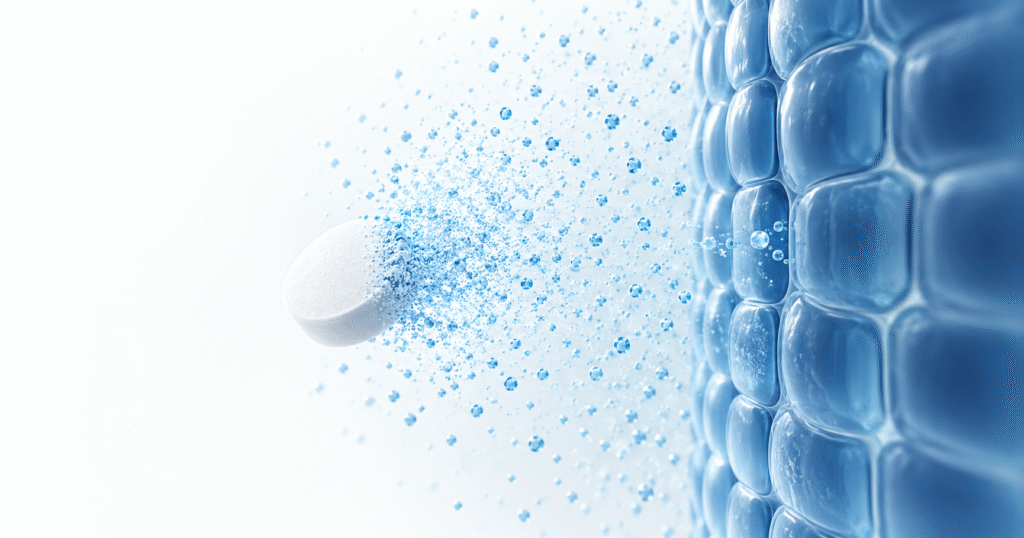
The gut is a machine for taking proteins apart
Start with what the organ is for. Pepsin in the stomach; trypsin and chymotrypsin in the small intestine; a queue of peptidases behind them. A peptide drug arriving by mouth is, to that system, indistinguishable from lunch.
Nothing has malfunctioned when the drug is digested. The system is working exactly as designed.
Even intact, it cannot get through
Survive the enzymes and the second barrier is geometry. Semaglutide is 4,114 daltons. Passive absorption across a cell membrane belongs to small, greasy molecules — a few hundred daltons, comfortably soluble in lipid. A peptide is large, water-loving and usually charged, so the route through the cell is closed to it.
The route between cells is closed as well. The tight junctions sealing one epithelial cell to the next are sized to keep molecules of that scale out. That is the entire job of an epithelium: admit small nutrients, exclude everything else. And before the drug reaches either route it has to cross a layer of mucus that is itself a diffusion barrier, renewed continuously and swept along by the gut.
So the drug is soluble and impermeable at the same time. It dissolves perfectly well, sits in the lumen unable to go anywhere, and is digested while it waits. This is the point at which the usual formulation levers stop working — improving dissolution cannot help a molecule whose problem was never dissolution.
It is also why most medicines never face this. The great majority of oral drugs are small molecules under five hundred daltons that cross the epithelium unassisted. Peptides are the exception, and they are the exception by a wide margin.
The answer the field arrived at
If you cannot change the molecule, change the wall.
A permeation enhancer does exactly that, temporarily. Sodium caprate loosens the junctions between cells and fluidises the membrane. Salcaprozate sodium works differently: it raises the pH immediately around the eroding tablet, which inactivates pepsin and helps the peptide stay in the smaller, more permeable form it needs to be in to cross at all.
Neither agent does anything to the drug. Both do something brief to the barrier.
Why “brief” is the whole difficulty
Three published constraints bound how much that buys.
- A threshold. The enhancer does nothing below a certain concentration — for sodium caprate, roughly 8 to 13 millimolar at the tissue.
- A clock. Sodium caprate reaches its own peak blood concentration in about seven minutes. Measured directly in human intestine, the permeability increase lasts around twenty minutes and is gone by forty.
- A volume. The dose disperses into somewhere between 45 and 105 millilitres of gut fluid — and that volume is not the same on any two days.
Reach a threshold measured in the low tens of millimolar, inside a twenty-minute window, in a diluting volume nobody controls. One per cent is what that arithmetic returns.
What is actually in the tablet
The approved set is small enough to list in full.
- Semaglutide tablets — Rybelsus, and the oral Wegovy and Ozempic tablets — carry salcaprozate sodium (SNAC), 300 mg per tablet, alongside magnesium stearate. Absolute bioavailability around 0.8%, and roughly 1–2% for the newer tablet.
- Octreotide capsules — Mycapssa — use sodium caprylate, the C8 fatty acid salt, in an oily suspension. Oral bioavailability of the order of 0.5%.
- Enlicitide tablets — LIPFENDRA, approved this year as the first oral PCSK9 inhibitor — use sodium caprate, the C10 salt. The label states that it “facilitates the oral absorption of enlicitide”, and puts the bioavailability at “approximately 1%”.
Three approved products, three different peptides, three enhancers drawn from the same medium-chain family — a capped C8, a C8 and a C10. Within that family the choice does matter: when Novo Nordisk compared enhancers head to head on the same molecules, dog exposures moved by more than a factor of two on enhancer identity alone.
Read the dosing instructions
There is a tell on the labels of all three products, and it is easy to skim past.
LIPFENDRA is to be taken “on an empty stomach in the morning with water, black coffee, or plain tea”, and the patient must “wait at least 30 minutes before eating food or drinking beverages other than water, black coffee, or plain tea”. Oral semaglutide carries a comparable rule: first thing, with no more than a few ounces of water, then half an hour before anything else.
Most medicines carry no instruction of that kind, and the ones that do usually carry it for tolerability — take with food, avoid alcohol. These rules are different in kind. They exist because the enhancer has to reach its threshold concentration against the stomach wall, and food and fluid dilute it below that threshold before it can act.
In other words, the dosing ritual is not advice about how to take the medicine comfortably. It is part of how the medicine works, handed to the patient to execute. A tablet whose performance depends on the patient drinking less water has moved part of its formulation out of the factory and into the kitchen.
What one per cent costs
It shows up first in the tablet itself. An oral semaglutide tablet carries 300 mg of SNAC to deliver 25 mg of peptide. The enhancer is most of the functional mass of the medicine; the active ingredient is close to a rounding error by weight.
It shows up next in the factory. At one per cent, you manufacture between fifty and a hundred times the drug that ever reaches a patient.
And it shows up last in which molecules are eligible at all. A hundredfold loss is survivable only for a drug that is potent, chemically robust, forgiving of being over- or under-dosed, and long-lived enough in the blood to absorb a bad day. Semaglutide is all four, with a half-life of about a week. Insulin is none of them.
One per cent is not a failure of formulation science. It is the price of asking a barrier organ to admit something it was built to exclude — and only certain molecules can afford to pay it.
Which leaves a second question, and a less comfortable one. If one per cent is the price, is it at least a reliable price? The published answer is no, and that is the subject of the companion to this article.
George Forrest is CEO and co-founder of Ibumix, a UK pharmaceutical company working on oral bio-enhancers. This article surveys published work; it does not describe Ibumix’s own.
Sources
- OZEMPIC (semaglutide) US prescribing information — absolute bioavailability 89% subcutaneous — https://www.novo-pi.com/ozempic.pdf
- WEGOVY tablets US prescribing information — 300 mg SNAC with 25 mg semaglutide — https://www.accessdata.fda.gov/drugsatfda_docs/label/2025/218316Orig1s000lbl.pdf
- LIPFENDRA (enlicitide) US prescribing information — sodium caprate; bioavailability “approximately 1%” — https://www.merck.com/product/usa/pi_circulars/l/lipfendra/lipfendra_pi.pdf
- Mycapssa (octreotide) EU product information — the caprylate-based permeation enhancer — https://www.ema.europa.eu/en/medicines/human/EPAR/mycapssa
- Buckley et al., Transcellular stomach absorption of a derivatized GLP-1 receptor agonist, Sci Transl Med 2018 — https://pubmed.ncbi.nlm.nih.gov/30429357/
- Twarog et al., Intestinal permeation enhancers: SNAC and sodium caprate compared, Pharmaceutics 2019 — https://www.mdpi.com/1999-4923/11/2/78
- Maher, Mrsny & Brayden, Intestinal permeation enhancers for oral peptide delivery, Adv Drug Deliv Rev 2016 — https://pubmed.ncbi.nlm.nih.gov/27320643/
- Maher & Brayden, Intestinal permeation enhancers: reasons for low efficacy in humans, Expert Opin Drug Deliv 2021 — https://www.tandfonline.com/doi/full/10.1080/17425247.2021.1825375
- Niu et al., Combining SNAC and C10 in oral tablet formulations, J Control Release 2025 — https://www.sciencedirect.com/science/article/pii/S016836592400837X