
Why pharmaceutical science is heading to orbit
From cancer antibodies that crystallise more cleanly 400 kilometres above the Earth, to autonomous capsules that manufacture a drug in orbit and parachute it home, microgravity has moved from scientific curiosity to a working instrument of pharmaceutical research — valued less as a place to manufacture medicines than as a way to understand them. Here is what the field has learned, why it matters, and where it is heading.
Ibumix Industry Insight · Approx. 10-minute read
A laboratory that gravity cannot reach
In 2017, researchers at Merck — known as MSD outside North America — sent samples of pembrolizumab to the International Space Station. Pembrolizumab is the antibody behind Keytruda, one of the best-selling cancer immunotherapies in the world. On the ground, the antibody crystallised into an uneven mixture of large and small particles. In orbit, the same chemistry produced something far tidier: a uniform suspension of crystals clustered around a single size, roughly 39 micrometres across, against a ground sample that scattered between 13 and 102 micrometres. The team published the result in 2019 in the journal npj Microgravity.
That contrast — a clean, single-size population of crystals versus a disordered spread — is not a laboratory curiosity. It is, in miniature, the difference between a medicine that can only be infused slowly into a vein and one that might be delivered as a quick injection under the skin. The experiment did not, by itself, create a new product. But it became the most widely cited demonstration of a simple and counter-intuitive idea: some medicines are easier to make well when gravity is taken out of the equation.
In the years since, pharmaceutical science has quietly built a working presence in low Earth orbit. This is no longer the territory of science fiction. It is a measurable, funded and increasingly regulated field of research, with established companies and well-capitalised start-ups, a growing body of peer-reviewed results, and the close attention of national regulators.
This article also takes a position. Its argument is that the value of microgravity to pharmaceutical science lies not in space becoming a destination for drug manufacturing, but in microgravity working as an instrument — a way to observe, and then to capture, behaviour that gravity ordinarily conceals. What follows is an account of why microgravity helps, how it helps, what is being done right now, and where the field is likely to go.
Microgravity, not zero gravity
The phrase “zero gravity” is convenient shorthand, but it is not accurate, and the distinction is worth understanding because it explains the whole field. Astronauts and experiments aboard the International Space Station are not beyond the reach of gravity. At the station’s altitude — around 400 kilometres — the Earth still pulls with roughly 90 per cent of the force felt at the surface.
Things float not because gravity is absent, but because the station and everything inside it are in a continuous state of free fall, perpetually falling around the planet as they orbit. The accurate term is microgravity: a state in which the residual accelerations acting on an object are on the order of a millionth of those felt on the ground. The value to pharmaceutical science comes not from removing gravity itself, which is impossible, but from removing its everyday effects on liquids and suspensions. That is a subtle point with large consequences.
Why gravity is the problem
On Earth, gravity does two things to a fluid that quietly undermine delicate processes. The first is sedimentation: anything denser than the surrounding liquid sinks, and anything lighter rises. The second is buoyancy-driven convection: warmer or less concentrated regions of a fluid rise while cooler or denser regions fall, stirring the whole volume into slow, restless currents.
For a chemist trying to grow a high-quality crystal, both are obstacles. A protein crystal forming in solution is denser than the liquid around it, so it sinks and collides with its neighbours and with the walls of its container. Convection currents sweep fresh material past the growing crystal unevenly, so it grows quickly on one face and slowly on another, locking strain and defects into its structure. For a biologist trying to culture cells, gravity is just as unhelpful: cells settle to the bottom of the dish and spread into a flat sheet that behaves very little like living tissue.
In microgravity, these forces all but vanish. Sedimentation effectively stops. Convection gives way to gentle diffusion, in which molecules drift and settle into place rather than being churned. A crystal can grow slowly, evenly and undisturbed, with molecules joining the lattice in an orderly queue rather than a scramble. Around each growing crystal a stable depletion zone forms — a shell of fluid from which protein has been drawn down — and because nothing sweeps it away, the crystal builds from a calm and even local environment (Figure 1). Cells, no longer pinned to a surface, are free to assemble in three dimensions into the rounded structures they would naturally form in the body.
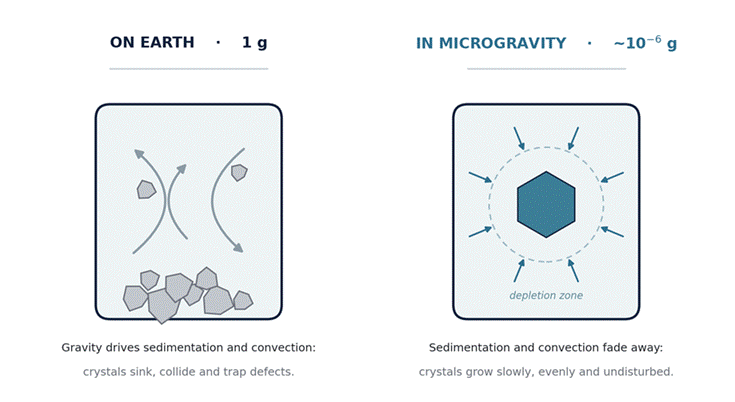
Figure 1 — Gravity at work, and at rest. On Earth, convection stirs the growing solution while sedimentation pulls crystals down; in microgravity both effects fade, and a crystal grows suspended, fed evenly by quiet diffusion.
Microgravity does not introduce anything exotic. It removes a source of noise that researchers on the ground have spent decades engineering around.
The advantages: what microgravity actually delivers
The benefits to pharmaceutical research fall into four broad areas.
The first is higher-quality protein crystals for structural biology. To design a drug against a biological target, scientists need to know that target’s three-dimensional shape in fine detail, and the workhorse technique for obtaining it — X-ray crystallography — depends on well-ordered crystals. Crystals grown in microgravity are frequently larger, more uniform and more internally ordered than their terrestrial counterparts, and they diffract X-rays to higher resolution. That extra detail can reveal an active site or a bound molecule with a clarity that directly informs structure-based drug design.
The second is uniform crystalline suspensions for reformulation. This is the territory of the pembrolizumab result. Many of the most important modern medicines are large, complex biologic molecules, and many can only be given by intravenous infusion because they cannot be concentrated enough to inject under the skin without becoming too thick or unstable. Crystallising an antibody into a population of uniform, dense particles is one route to a high-concentration but still low-viscosity suspension — the kind of formulation that could be delivered in seconds from a syringe. Uniform particle size also brings more predictable dissolution and release behaviour (Figure 2).
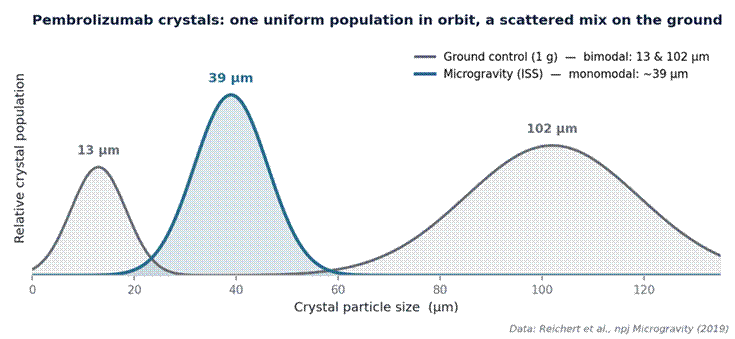
Figure 2 — The pembrolizumab result. In orbit, the antibody formed a single, uniform population of crystals near 39 µm; the matched ground control split into a scattered, bimodal mix of roughly 13 µm and 102 µm particles.
The third is more realistic three-dimensional cell culture. Free from sedimentation, stem cells and tissue cells assemble into larger, sturdier three-dimensional aggregates — spheroids and organoids — without the synthetic scaffolds usually needed to coax them into shape on the ground. These structures are far closer to real tissue than a flat cell layer, which makes them better models of tumours, organs and disease, and therefore better testing grounds for candidate drugs. Some studies also report that cells expand faster and tissues mature more quickly in orbit.
The fourth, underpinning the others, is a quieter and cleaner processing environment. With convection suppressed, mixing is gentler and more uniform, and sensitive biological materials are subjected to less mechanical and thermal stress while they form.
How it helps: from the orbital bench to the patient
These advantages matter only if they reach patients, and the clearest illustration is again the reformulation story. An intravenous infusion can tie a patient to a chair in a clinic for half an hour or more, and it occupies scarce infusion-suite capacity and nursing time. A subcutaneous injection can be administered in a minute or two, opens the door to treatment closer to home, and eases the load on hospital systems. The pharmaceutical value of that shift is considerable: in September 2025, a subcutaneous formulation of pembrolizumab was approved by the US Food and Drug Administration. That particular product reached the clinic by a different formulation route, but the prize it represents — shorter treatment times, the prospect of care outside hospital, lighter demands on infrastructure — is precisely the target that microgravity formulation science is pursuing across the wider portfolio of biologic medicines.
It is important to be clear about the model. The goal, for the most part, is not to manufacture every dose of a medicine in space. The more realistic near-term approach is to treat orbit as a research and process-development environment: to learn, in microgravity, what the ideal crystal form or particle size for a given drug looks like, and then to translate that understanding back into a manufacturing process on the ground. Merck did exactly this, carrying its orbital findings back into terrestrial production. In this model, space functions as a research instrument — an unusually capable one — rather than as a permanent factory. That is the heart of the argument made here: orbit earns its place in modern medicine as an instrument, not as a destination.
For a narrower set of products — small in quantity, very high in value, or simply impossible to produce well on Earth — manufacturing the finished material in orbit may itself make commercial sense. Either way, the downstream benefits are the same in kind: better structural data accelerates discovery, better disease models reduce the rate of failure in clinical trials, and better formulations improve how medicines are stored, transported, administered and tolerated.
The work in progress
Several distinct programmes are now running in parallel, and together they show a field moving from one-off experiments towards repeatable capability.
Merck’s collaboration with the ISS National Laboratory remains the touchstone. Its crystallisation experiments with pembrolizumab, and related work on other proteins, established both the scientific result and the template for translating an orbital finding into a process that runs on the ground.
Redwire, an established space-infrastructure company, operates a service it calls the Pharmaceutical In-space Laboratory, built around automated crystallisation cassettes — the PIL-BOX family — that have flown repeatedly to the International Space Station on behalf of pharmaceutical and academic clients. The company has now introduced a high-volume Industrial Crystalliser capable of processing samples up to two hundred times the volume of its original units: a deliberate step from experiment towards production scale. Redwire has also bioprinted human cardiac tissue in orbit.
Varda Space Industries has taken a different route. Rather than relying on a crewed station, it builds small, autonomous capsules that carry out a manufacturing process in orbit and then re-enter the atmosphere to deliver the product. Its first capsule, which returned to Earth in 2024, produced crystals of the antiviral drug ritonavir, including a crystalline form that is difficult to make reliably on the ground. Subsequent capsules have made the cycle increasingly routine, and Varda became the first company to hold a US re-entry operator licence under the Federal Aviation Administration’s Part 450 framework, allowing it to fly capsules without re-filing safety documentation for every mission.
BioOrbit, a British company founded in 2023, is building a compact, modular and autonomous crystallisation unit — about the size of a domestic microwave oven — designed to take antibody crystallisation from a single experiment to industry-ready scale, with at-home cancer treatment as the explicit aim. It has raised one of the largest seed funding rounds the field has seen, close to £10 million, and has received a feasibility grant from the UK Space Agency.
Beyond crystallisation, public agencies are pursuing microgravity for biological research. NASA’s Tissue Chips in Space initiative places organ-on-chip systems in orbit to model disease, and the European Space Agency supports a Microgravity for Personalised Medicine programme developing tumour and organoid models. In one notable result, human neural organoids cultured on the ISS remained healthy after a month in orbit and showed signs of faster maturation than equivalent cultures on the ground. Coordinating much of this activity is the ISS National Laboratory, which has functioned as the connective tissue — funding, brokering and publishing — for a large share of the field’s pharmaceutical work.
The challenges that remain
A balanced account has to acknowledge that this is a young industry, and a demanding one. Sober analysts point out that a mature market for in-space manufacturing does not yet fully exist; some argue the field has only recently crossed a commercial tipping point, and others remain unconvinced the business case is proven.
Cost is the most obvious constraint. Launching material to orbit and returning it safely is expensive. One early autonomous-manufacturing mission has been described by its operator as costing in the region of twelve million US dollars, with a stated target of bringing that closer to two million — figures that, for now, restrict in-space production to high-value products.
Scale is the second constraint. The International Space Station and small capsules produce modest quantities. The realistic path forward is either to use space-grown crystals as reference points or as seeds for larger ground-based processes, or to concentrate on the narrow set of products where orbital production pays for itself. Industrial-scale crystallisers are an answer in progress, not a finished one.
There are also practical difficulties of reproducibility and logistics. Crystallisation can be hard to control even in ideal conditions — the same recipe may yield a crystal in minutes on one occasion and over weeks on another — and atmospheric re-entry demands the coordination of landing ranges and narrow orbital windows. And the workhorse of the field, the International Space Station, is expected to be retired around 2030, which makes the question of what comes next far from academic.
Where the future is heading
The trajectory of the field points in a consistent direction. As the International Space Station approaches retirement, a generation of commercial space stations is being prepared to take its place — among them Vast’s Haven-1 and Axiom Space’s modules — and these are being designed with manufacturing in mind, not research alone. Alongside them, the autonomous free-flyer model pioneered by Varda, a capsule that manufactures and returns with no crew and no station, offers a route that is inherently repeatable and scalable. Falling launch costs and rising flight cadence steadily improve the economics of both.
Regulation is maturing in step. In March 2026, the United Kingdom set out a coordinated pathway for space-manufactured medicines, bringing together the UK Space Agency, the Medicines and Healthcare products Regulatory Agency, the Civil Aviation Authority and the Regulatory Innovation Office, with regulatory guidance, worked case studies and a dedicated re-entry sandbox. It built on the regulator’s 2025 framework for decentralised and modular manufacturing. The significance lies less in any single measure than in the signal: national regulators now treat medicines made in orbit as a route to be supported and standardised, rather than a curiosity to be handled case by case.
The numbers reflect the same momentum. The broader in-space manufacturing market was valued at roughly 1.2 billion US dollars in 2025 and is widely projected to grow at more than twenty per cent a year for the rest of the decade, with pharmaceuticals among its leading segments. The direction of travel is from experiment to production — or, as one industry executive put it, towards making the whole endeavour “boring.” In a field that has spent a decade proving that its science is real, routine is the highest ambition.
A vantage point worth having
Microgravity will not replace the terrestrial pharmaceutical factory, and no serious participant in the field claims it should. What it offers is something more specific and more durable: a setting in which the ordinary rules of fluid behaviour are suspended long enough for researchers to see how a molecule, or a cell, organises itself when gravity is not interfering. For a discipline whose hardest problems are so often problems of formulation, stability and delivery, that is a vantage point of real value.
The medicines that benefit will, in the end, still be made and given on Earth; orbit is the instrument, not the destination. But a growing share of what makes them better — purer crystals, sharper structures, more uniform suspensions, more lifelike tissue models — will have been learned a long way above it.
M E D I C I N E I N F R E E F A L L
Sources & further reading
— Reichert et al., “Pembrolizumab microgravity crystallization experimentation,” npj Microgravity (2019) https://www.nature.com/articles/s41526-019-0090-3
— ISS National Laboratory — Merck pembrolizumab results and pharmaceutical research https://issnationallab.org/blog/merck-lab-publishes-pembrolizumab-results
— GOV.UK — “UK sets out world-leading pathway for space-manufactured drugs” (5 March 2026) https://www.gov.uk/government/news/uk-sets-out-world-leading-pathway-for-space-manufactured-drugs
— Varda Space Industries — in-space pharmaceutical manufacturing https://www.varda.com/science/pembrolizumab-microgravity-crystallization-experimentation/
— Redwire Space — Pharmaceutical In-space Laboratory (PIL-BOX) https://redwirespace.com/newsroom/redwire-expands-in-space-drug-development-program-launches-new-pil-box-technology-and-cancer-detection-experiment/
— BioOrbit — scaling protein crystallisation in microgravity https://www.bioorbit.space/
— ITIF — “Drug Development in Microgravity” (2025) https://itif.org/publications/2025/05/27/drug-development-in-microgravity-the-next-frontier-in-biopharmaceutical-innovation/
— US FDA — approval of subcutaneous pembrolizumab (September 2025) https://www.fda.gov/drugs/resources-information-approved-drugs/fda-approves-pembrolizumab-and-berahyaluronidase-alfa-pmph-subcutaneous-injection
Published by Ibumix (www.ibumix.com) as an industry insight. This article is informational and does not describe Ibumix products or services. Figures prepared by Ibumix; Figure 2 data from Reichert et al., npj Microgravity (2019).