Drug Delivery as the Missing Layer in the AI-Enabled Pharmaceutical Stack
Abstract
Artificial intelligence (AI) is reshaping pharmaceutical research by accelerating target identification, molecular design, and predictive modelling. However, improvements in early-stage efficiency have not translated proportionally into clinical success. A central, under-addressed limitation is oral drug delivery—specifically, the failure to achieve reliable systemic exposure for poorly water-soluble compounds. Here, we argue that drug delivery constitutes the critical missing layer in the AI-enabled pharmaceutical stack. We synthesise evidence from lipid-based drug delivery systems (LBDDS) and pharmacokinetic science to propose an absorption-centric framework for modern formulation. We introduce two conceptual models—the Absorption Cascade™ and the Intelligent Drug Stack™—to integrate AI-driven discovery with lipid-enabled delivery. We conclude that the future of pharmaceutical innovation will depend on convergence between computational design and biologically adaptive delivery systems.
1. Introduction
Recent advances in AI have transformed drug discovery, enabling rapid exploration of chemical space, improved target validation, and predictive modelling of absorption, distribution, metabolism, excretion and toxicity (ADMET) (Mak & Pichika, 2019; Vamathevan et al., 2019). These developments are widely expected to reduce costs and timelines across the pharmaceutical pipeline.
Despite this progress, clinical attrition rates remain high. Late-stage failures are frequently driven not by insufficient target engagement, but by inadequate pharmacokinetic performance (Waring et al., 2015). This discrepancy highlights a structural imbalance: while discovery has become increasingly optimised, delivery remains comparatively underdeveloped.
We propose that oral drug delivery—specifically, the control of in vivo absorption—represents the principal bottleneck limiting the translational impact of AI in pharmaceuticals.
2. The Persistent Challenge of Oral Bioavailability
A substantial proportion of new chemical entities (NCEs)—estimated at 70–90%—exhibit poor aqueous solubility, limiting oral bioavailability (Lipinski et al., 2001; Kalepu & Nekkanti, 2015). These compounds are particularly susceptible to:
- Incomplete dissolution in gastrointestinal fluids
- Low permeability across intestinal epithelia
- Pre-systemic metabolism
- High inter-patient variability
Traditional pharmaceutical development has relied heavily on in vitro dissolution testing as a surrogate for in vivo performance. However, the predictive value of dissolution is limited, particularly for lipophilic compounds (Kostewicz et al., 2014).
This has led to a critical misalignment between laboratory metrics and clinical outcomes.
Dissolution is a necessary condition for absorption—but not a sufficient one.
3. AI and the Limits of Predictive Optimisation
AI systems excel in modelling structured biochemical interactions, such as ligand–receptor binding or protein folding. However, oral drug absorption is governed by a highly dynamic and heterogeneous physiological environment.
The gastrointestinal tract involves:
- Variable pH conditions
- Enzymatic activity
- Lipid digestion processes
- Bile salt-mediated solubilisation
- Complex transport pathways
These processes are inherently nonlinear and context-dependent, limiting the predictive power of current AI approaches (Dressman & Reppas, 2000).
As a result, AI-optimised molecules may still fail at the point of biological interface.
4. Lipid-Based Drug Delivery Systems as Enabling Technologies
Lipid-based drug delivery systems (LBDDS) have emerged as a robust strategy to address the limitations of poorly soluble drugs. These systems include self-emulsifying drug delivery systems (SEDDS), self-microemulsifying systems (SMEDDS), and nanoemulsions.
Mechanistically, LBDDS enhance oral bioavailability through:
- Solubilisation of lipophilic drugs in gastrointestinal fluids
- Formation of colloidal species (e.g. micelles, vesicles)
- Interaction with bile salts and endogenous lipids
- Facilitation of intestinal transport
- Promotion of lymphatic uptake, reducing hepatic first-pass metabolism
(Porter et al., 2007; Pouton, 2006; Feeney et al., 2016)
These systems operate through dynamic, in situ transformations, rather than static dissolution processes.
Lipid-based systems function not as passive excipients, but as active determinants of pharmacokinetic behaviour.
5. The Absorption Cascade™: A Systems Framework
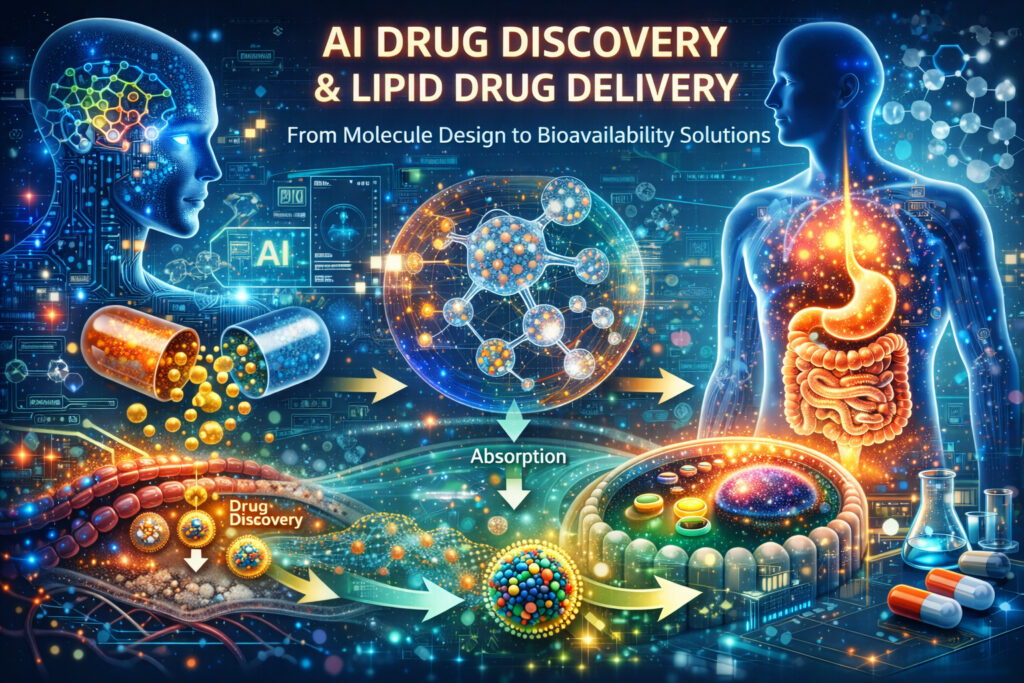
To conceptualise the role of lipid-based delivery, we propose the Absorption Cascade™, a five-stage model describing the transformation of an orally administered drug into a systemically available entity:
- Dispersion – Initial release into gastrointestinal fluids
- Transformation – Enzymatic digestion of lipid components
- Self-Assembly – Formation of nano-scale colloidal structures
- Transport – Uptake via enterocytes and lymphatic pathways
- Systemic Availability – Entry into circulation
Each stage is governed by interactions between formulation composition and physiological processes. Disruption at any stage may significantly reduce bioavailability.
This model underscores that absorption is an emergent property of a dynamic system—not a single measurable parameter.
6. The Intelligent Drug Stack™
To integrate these insights within the broader pharmaceutical landscape, we introduce the Intelligent Drug Stack™, comprising four interdependent layers:
- Discovery Layer (AI-driven)
Target identification and molecular design - Prediction Layer (Computational modelling)
ADMET prediction and simulation - Formulation Layer (Underdeveloped)
Drug delivery and absorption optimisation - Clinical Layer
Real-world patient outcomes
While AI has transformed the first two layers, the formulation layer remains a critical bottleneck.
Without advances in delivery, gains in discovery efficiency may not translate into clinical success.
7. Economic Implications of Delivery Failure
The economic burden of pharmaceutical development is substantial, with average costs exceeding $2 billion per approved drug (DiMasi et al., 2016). Failures due to inadequate bioavailability contribute significantly to these costs.
Consequences include:
- Increased dosing requirements
- Greater incidence of adverse effects
- Reduced therapeutic consistency
- Late-stage clinical attrition
Conversely, formulation strategies—particularly lipid-based approaches—offer opportunities to:
- Improve success rates
- Extend product lifecycles
- Enhance value extraction from existing compounds
Thus, bioavailability represents not only a scientific challenge, but a central determinant of capital efficiency.
8. Convergence: AI-Driven Discovery and Lipid-Enabled Delivery
The future of pharmaceutical innovation lies in the integration of:
- AI-driven molecular design
- Biologically adaptive delivery systems
Rather than competing paradigms, these approaches are complementary.
AI enables:
- Faster identification of promising compounds
Lipid-based systems enable:
- Realisation of their therapeutic potential in vivo
This convergence suggests a shift toward absorption-first design principles, in which delivery considerations are integrated early in the development process.
9. Conclusion
AI is redefining how drugs are discovered.
However, discovery alone does not ensure therapeutic success.
Oral drug delivery—specifically, the ability to achieve reliable and efficient absorption—remains a limiting factor across the pharmaceutical pipeline.
We propose that:
- Dissolution-centric models should be replaced with absorption-centric frameworks
- Lipid-based delivery systems should be recognised as core enabling technologies
- Formulation science should be elevated to a primary role within the drug development stack
The future of medicine will be determined not only by what can be designed, but by what can be absorbed.
References
DiMasi, J.A., Grabowski, H.G. & Hansen, R.W. (2016). Innovation in the pharmaceutical industry: New estimates of R&D costs. Journal of Health Economics, 47, pp.20–33.
Dressman, J.B. & Reppas, C. (2000). In vitro–in vivo correlations for lipophilic, poorly water-soluble drugs. European Journal of Pharmaceutical Sciences, 11(S2), pp.S73–S80.
Feeney, O.M., Crum, M.F., McEvoy, C.L., Trevaskis, N.L., Williams, H.D., Pouton, C.W. & Porter, C.J.H. (2016). 50 years of oral lipid-based formulations. Advanced Drug Delivery Reviews, 101, pp.167–194.
Kalepu, S. & Nekkanti, V. (2015). Insoluble drug delivery strategies: Review of recent advances. Acta Pharmaceutica Sinica B, 5(5), pp.442–453.
Kostewicz, E.S. et al. (2014). In vitro models for the prediction of in vivo performance of oral dosage forms. European Journal of Pharmaceutical Sciences, 57, pp.342–366.
Lipinski, C.A. et al. (2001). Experimental and computational approaches to estimate solubility and permeability. Advanced Drug Delivery Reviews, 46(1–3), pp.3–26.
Mak, K.K. & Pichika, M.R. (2019). Artificial intelligence in drug development. Drug Development Research, 80(7), pp.836–842.
Porter, C.J.H., Trevaskis, N.L. & Charman, W.N. (2007). Lipid-based formulations as enabling technologies for oral drug delivery. Nature Reviews Drug Discovery, 6(3), pp.231–248.
Pouton, C.W. (2006). Formulation of poorly water-soluble drugs for oral administration. European Journal of Pharmaceutical Sciences, 29(3–4), pp.278–287.
Vamathevan, J. et al. (2019). Applications of machine learning in drug discovery and development. Nature Reviews Drug Discovery, 18(6), pp.463–477.
Waring, M.J. et al. (2015). An analysis of the attrition of drug candidates. Nature Reviews Drug Discovery, 14(7), pp.475–486.