
The compressed tablet was a 19th-century manufacturing fix. It became the unquestioned default of modern medicine.
Modern medicine can design a molecule atom by atom — then deliver it in a format invented in 1843 to make better pencils. That is not an accident of history. It is a design choice, and it is overdue for review.
· 6-minute read
The system was designed backwards
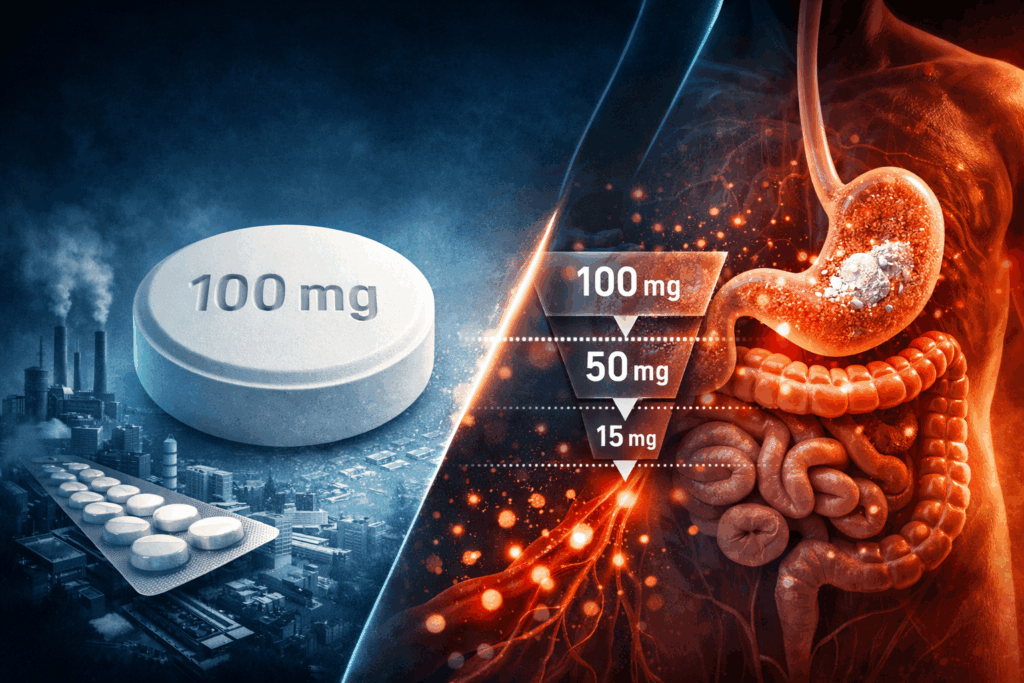
In 1843, an English painter named William Brockedon was granted a patent for a machine that pressed loose powder into a solid shape inside a die. Brockedon was not trying to change medicine. He wanted a better pencil — a way to compact graphite into leads that did not crumble. A drugs manufacturer recognised the larger use, engaged him, and the compressed tablet was born.
The dominant format of modern medicine began as a way to make a sturdier pencil.
Almost two centuries later, that same object — powder, compressed in a die — is still how most medicine reaches most people. The molecule inside it has changed beyond recognition. The tablet around it has barely changed at all.
This matters because modern medicine looks, in every other respect, advanced. Drug molecules are designed atom by atom. Late-stage trials run into hundreds of millions. Discovery is increasingly handed to machine learning. And then, at the final step, that effort is pressed into a delivery format whose design logic was settled when the governing priority was industrial throughput.
The gap is not subtle. An industry will spend a decade and a fortune refining how a single molecule behaves in the body — its receptor binding, its metabolism, its safety margin — and then accept, almost without comment, that the final step of delivering it still runs on Victorian engineering. The sophistication stops at the factory door.
The uncomfortable conclusion sits quietly underneath the whole industry: pharmaceutical systems are optimised for manufacturing efficiency, not for human biology.
The original constraint
The tablet earned its place. It is worth being precise about what it solved:
- Standardisation — every unit identical to the last.
- Stability — a dry compressed solid keeps for years.
- Scalability — a die can run, and run, and run.
Those three properties let medicine be produced by the million, shipped, stored and dispensed at a scale that genuinely extended human life. The compressed tablet did not merely supply the modern pharmaceutical industry; in large part it created it.
But a solution that good tends to harden into an assumption. The question the industry organised itself around was how do we manufacture this at scale — and, in time, that became the question asked first, and structurally the only one asked at all. The questions left off the design table were the ones that matter most to the person holding the medicine. How much of this dose will the body actually absorb? Does this dose suit this patient? Can this person physically swallow it? Those are not soft questions; they decide whether the medicine works at all.
The cost of that ordering is visible in the pipeline today. An estimated 70 to 90% of drug candidates now in development are poorly water-soluble, as is roughly a third of the medicines already on the market. A compound that dissolves poorly is a compound the body absorbs unreliably. When the delivery format is fixed in advance as a compressed solid, poor solubility becomes a problem to be patched downstream — rather than a property designed for from the start.
The cost of convenience
Every tablet quietly outsources the hardest part of its own job to the patient. Before a drug can act, the tablet must do three things in sequence:
- Disintegrate — break apart in the gut.
- Dissolve — pass into solution.
- Absorb — cross into the bloodstream.
Each step is a point of failure, and each is governed by conditions no manufacturer controls: the acidity of a particular stomach on a particular morning, whether the dose was taken with food, the individual physiology of the patient.
The same tablet, swallowed with breakfast or on an empty stomach, can deliver a materially different amount of drug into the bloodstream. That variability is not a rare edge case. It is built in — and it is the patient, not the formulator, who ends up setting the dose that actually lands.
The economics make that waste sharper. Bringing a single new drug to market is estimated to cost well over US$1bn — by several measures more than US$2bn — and only around one in ten candidates that reaches human trials is ever approved. After investment on that scale in the molecule, its real-world performance is left resting on a delivery step designed for the convenience of the production line.
The format also excludes people outright. Roughly one in six adults reports difficulty swallowing, and among older adults the figure rises towards 40%. For them, the dominant form of medicine fails before it can begin to work. The everyday workarounds — crushing a tablet, splitting it, or simply skipping it — each change the dose the body receives, or remove it altogether.
That connects to a failure the health system already counts in hundreds of billions. Medication non-adherence — patients not taking medicines as prescribed — is estimated to cost the United States between US$100bn and US$290bn each year, and is associated with around 125,000 deaths annually. The tablet is not the sole cause of that. But a delivery format that one adult in six finds hard to swallow is not a neutral place to begin.
A delivery format that one adult in six finds hard to swallow is not a neutral place to begin.
The inversion
Here is the part that should be uncomfortable. Across almost every other field, the last half-century has been one long migration toward the user.
- Software interfaces became things an ordinary person could use without a manual.
- Consumer products were redesigned around real behaviour rather than the assembly line.
- Friction, almost everywhere, came to be treated as a defect to be removed.
A modern car, a modern phone, a modern current account: each is now built on the assumption that the user will not read a manual, and is judged on how little it asks of them. The governing principle almost everywhere became simple — the product adapts to the human.
Pharma moved the other way. The compressed tablet kept its place at the centre of the system, and everything else — the dose, the schedule, the patient’s own body — was expected to adapt to it. It is close to the only major consumer-facing field in which the core format has been allowed to stand still for the better part of two centuries while everything around it was rebuilt.
Pharma built a system in which the patient adapts to the product, rather than the product to the patient.
What changes next
None of this means the tablet was a mistake. It means the tablet was a precise answer to a 19th-century question — and the 21st century is asking different ones.
The next era of medicine inverts the order of priorities:
- From compression to absorption — designing for what the body takes up, not for what the die can press.
- From standardisation to precision — a dose shaped to the patient, not to the production line.
- From manufacturing-first to human-first — the format following the biology, instead of the biology being told to follow the format.
Human-first does not mean abandoning scale or stability; those constraints are real and permanent. It means treating absorption, dosing accuracy and the patient’s experience as design targets from the first sketch — not as problems inherited at the end of the line.
Liquid and absorption-led delivery systems are among the clearest expressions of that shift: formats built so that the body’s variability is engineered for, rather than left to chance. The work involved is technical and unglamorous — solubility, stability, dosing accuracy, manufacturability at scale. But the question underneath it has finally moved.
Ibumix works at exactly that point of change. The interesting problem is no longer how to press a better tablet. It is whether a technique invented to make a sturdier pencil should still decide how a modern medicine reaches the body.
The goal is not to improve the pill. It is to retire the assumption that the pill is where medicine has to end.
Sources
- Science Museum Group. Brockedon metal pill die, Europe, 1843–1900. https://collection.sciencemuseumgroup.org.uk/objects/co131280/brockedon-metal-pill-die-europe-1843-1900
- Tablet (pharmacy) — origin and history of the compressed tablet. Wikipedia. https://en.wikipedia.org/wiki/Tablet_(pharmacy)
- Advancement in Solubilization Approaches: bioavailability enhancement of poorly soluble drugs. PMC. https://www.ncbi.nlm.nih.gov/pmc/articles/PMC10221903/
- US Department of Health and Human Services (ASPE). Examination of Clinical Trial Costs and Barriers for Drug Development. https://aspe.hhs.gov/reports/examination-clinical-trial-costs-barriers-drug-development-0
- Prevalence and Characteristics of Dysphagia Based on a Population-Based Survey. PMC. https://pmc.ncbi.nlm.nih.gov/articles/PMC7180111/
- Economic impact of medication non-adherence by disease groups: a systematic review. PMC. https://pmc.ncbi.nlm.nih.gov/articles/PMC5780689/
- Medication Adherence: Helping Patients Take Their Medicines As Directed. PMC. https://pmc.ncbi.nlm.nih.gov/articles/PMC3234383/
Part of the Ibumix series on the tablet’s limits. Start with the overview: Why the tablet is pharma’s bottleneck.