
Why ibuprofen is the cleanest test case in the world for a new generation of drug delivery — and the molecule on which Ibumix is developing the potentially fastest-onset over-the-counter painkiller in the world.
The molecule is not the variable. The delivery system is. The peer-reviewed data has been clear for two decades — and most of the world’s most-used painkiller is still designed as if it were not.
By Ibumix · 8-minute read
In a 2019 randomised crossover trial published in Clinical Pharmacology in Drug Development, the same 400 mg dose of ibuprofen — the same patient, the same fasted morning, the same gut — reached peak plasma concentration in 30 minutes as a lysinate salt and 113 minutes as the standard acid. The molecule did not change. The delivery system did. The delivery system decided whether the dose was a medicine or a wait.
That single trial is not an outlier. A 2014 systematic review of 30 ibuprofen pharmacokinetic studies (1,015 subjects) put fast-acting salt and solubilised formulations at a Tmax of 29 to 35 minutes, against 90 minutes for the standard tablet. Absolute bioavailability of ibuprofen, across all of those formats, sits at 96 to 100% — the molecule fully arrives. It just takes its time.
The same drug. The same dose. Three times the time-to-effect, decided by a formulation choice the patient is never told about. This is the cleanest test case the industry has.
Ibuprofen is the test case the industry would rather not run. Its absorption is near-complete, so the only variable left is the delivery system. The delivery system wins.
The Therapeutic Window Most Doses Cross Late
Ibuprofen does not work in a binary way. It works in a concentration band. Published pharmacokinetic-pharmacodynamic modelling sets two thresholds: roughly 6.8 µg/mL for measurable analgesia and roughly 10.1 µg/mL for the stronger pain and fever response patients actually notice. Below the first number, the drug is statistically indistinguishable from placebo for many endpoints. Between the two numbers, it works, but inconsistently. Above the second, it does what the label implies.
Every formulation decision — salt form, dissolution rate, particle size, excipient chemistry, presence or absence of food in the gut — determines how fast those thresholds are crossed and how long they are held. A standard 400 mg tablet on a full stomach can take well over ninety minutes to reach the upper threshold. A solubilised or salt-form 400 mg tablet on an empty stomach can reach it in under thirty. The patient is taking the same medicine. They are not receiving the same medicine.
For a child with a fever, a post-operative patient waiting for the next dose, or a migraine sufferer trying to interrupt the prodrome, that hour is the medicine. Outside the window, the dose is technically present and clinically absent.
Four Tablets, Four Stories — One Molecule
A February 2026 study in the European Journal of Pharmaceutics and Biopharmaceutics compared four oral ibuprofen formulations head-to-head in matched volunteers under in vivo and PBPK-virtual conditions: a standard 400 mg immediate-release tablet; a standard 200 mg tablet; a 400 mg-equivalent lysinate salt; and a bi-layer tablet combining immediate-release and sustained-release components.
Same molecule. Same nominal dose for three of the four. Materially different medicines:
• The lysinate reached the therapeutic threshold faster than the acid — not by adding drug, but by changing how the drug presented to the gut wall.
• The bi-layer extended the therapeutic window meaningfully beyond what a single immediate-release dose can sustain — reducing the interval at which the next dose must arrive to keep the concentration in band.
• The 200 mg standard tablet underperformed the 400 mg standard tablet less than the dose ratio would predict — because the limiting variable was rate of absorption, not amount absorbed.
• The PBPK virtual trial reproduced the in vivo curves with R² values at or above 0.8 across the pharmacokinetic and pharmacodynamic endpoints — pre-empirical prediction of a formulation’s clinical behaviour is no longer aspirational.
The honest counter-finding from the clinical literature: in some pain models — for example post-operative dental pain — lysinate’s faster Tmax does not always translate into a statistically significant earlier onset of analgesia. The pharmacokinetic advantage is real and measured; the clinical readout is sometimes blunter than the absorption curve. This is a calibration problem, not a refutation. The medicine arrives earlier; the trial is sometimes not powered to see it.
The Dose Myth — Why More Is Not More Medicine
There is a quiet finding inside the same pharmacokinetic literature that the industry has been slow to engage with: ibuprofen has a relatively flat dose-response curve above the therapeutic threshold. Once plasma concentration is in band, further milligrams add diminishing clinical benefit and growing side-effect risk.
Across the published meta-analyses, a 30% increase in circulating drug typically translates into less than a 10% improvement in pain or fever endpoints. The other 20% goes somewhere — and the somewhere is the side-effect column: gastrointestinal irritation, renal load, platelet effects, blood pressure response. The dose-response curve is flat for benefit and steep for risk.
More milligrams is not more medicine. It is more risk for less return. The point of intervention is not the dose. It is the delivery.
This reframes the innovation question. The way to improve ibuprofen is not to raise the dose or invent a new molecule. It is to make the dose already on the label perform at the upper end of its own potential — reliably, across patients, regardless of meal state or gut motility.
The Bill for Imperfect Delivery
Inefficient delivery is not free. NSAIDs — of which ibuprofen is by some distance the most prescribed and most consumed — are responsible, in older patients, for an estimated 30% of all hospital admissions caused by adverse drug reactions. A 2016 editorial in the British Journal of General Practice (Davis and Robson) put the total UK NHS cost of preventable adverse drug reactions in older adults at the order of £800 million per year, with NSAIDs the single largest contributor by class. A 2024 NHS England-funded modelling study estimated that hazardous NSAID prescribing to five named high-risk groups alone would cost the NHS in the region of £31 million and the population more than 6,000 quality-adjusted life-years over a ten-year horizon.
The mechanism behind much of that cost is gastrointestinal. As much as half of all acid-suppression prescribing in the UK has been estimated to be downstream of NSAID-related GI effects. The drug arrives in the gut, dissolves, irritates the mucosa, is absorbed unevenly, peaks above what was needed, and leaves a bill on the way through. The bill is paid by patients, prescribers, and the public payer.
A delivery system that lowers the peak, holds the concentration in band, and reduces the local mucosal exposure does not just work better. It costs less to use. The clinical case and the health-economic case point in the same direction.
PBPK — From Empirical to Predictive Formulation
The methodological story behind the February 2026 EJPB study is as important as the clinical one. Physiologically based pharmacokinetic (PBPK) modelling, validated against in vivo data with R² at or above 0.8, is now mature enough to predict a formulation’s behaviour before it is dosed in a single human volunteer. The implication is operational: a formulation programme can run dozens of in silico candidates against a virtual population, surface the two or three that meet the pharmacokinetic specification, and dose those — not the dozen it would have dosed without the modelling layer.
This shifts formulation science out of the empirical era — try, dose, measure, iterate — into a predictive era — model, prioritise, dose to confirm. The cost curve of formulation development bends accordingly.
1843. 2026. One hundred and eighty years between the design of the tablet and the science required to design it properly. The gap is closing this decade.
The Architecture That Comes Next
If the molecule is not the variable and the dose is not the point of intervention, the architecture has to change. What that architecture looks like is starting to take a recognisable shape.
• Salt and solubilised forms move the active out of the dissolution-rate-limited regime by presenting it to the gut already in a state the gut can absorb.
• Lipid-based and amphiphile self-assembly systems — lamellar, hexagonal, and cubic mesophases — give a tunable interface between the active and the aqueous environment of the gut, controlling rate without sacrificing total uptake.
• Bi-layer and multi-phase architectures separate the immediate-release and sustained-release fractions of a dose so the same milligram count delivers a longer therapeutic window.
• Non-tablet formats — oral sprays, fast-dispersing films, liquid systems — move the active onto an absorbing surface immediately, bypassing the dissolution-rate-limited step that defines the tablet.
• PBPK-driven design lets the formulation be tuned to the therapeutic window of the molecule, not to the convenience of the manufacturing line.
Ibuprofen is the test case because its bioavailability is already near-complete. There is no headroom to be won by absorbing more. Every gain has to come from absorbing better — faster, more uniformly, with a peak shaped to the window rather than overshooting it. That is the case the next generation of oral delivery has to make, and ibuprofen is the cleanest molecule on which to make it.
A Prediction, Falsifiable by 2030
To put a date on the argument: by the end of 2030, at least one over-the-counter ibuprofen product on a major-market shelf will deliver a clinically demonstrated Tmax under fifteen minutes. The platform chemistry to enable it already exists in the open literature. The PBPK methodology to design it has been published and validated. The health-economic case — £800 million a year of preventable NHS cost in older patients alone, in the UK alone — is on the regulatory record.
The only remaining variable is which company moves first. The same observation applies to the broader analgesic shelf, but ibuprofen is where the demonstration is cleanest because its baseline bioavailability removes every excuse. If this prediction does not happen by 2030, the thesis was wrong. If it does, the tablet has been outpaced on its own home category — the format on which more pharmaceutical investment has been spent than on any other.
The Ibumix Position
Ibumix is building new liquid drug delivery platforms aimed at this gap — using amphiphile-driven self-assembly to engineer the rate, shape, and duration of absorption, rather than relying on dissolution chemistry the patient happens to have on a given morning. Ibuprofen and naproxen are the two starting molecules because they are the two cleanest places to demonstrate the principle: high-volume, well-characterised, fully bioavailable, and still under-delivered.
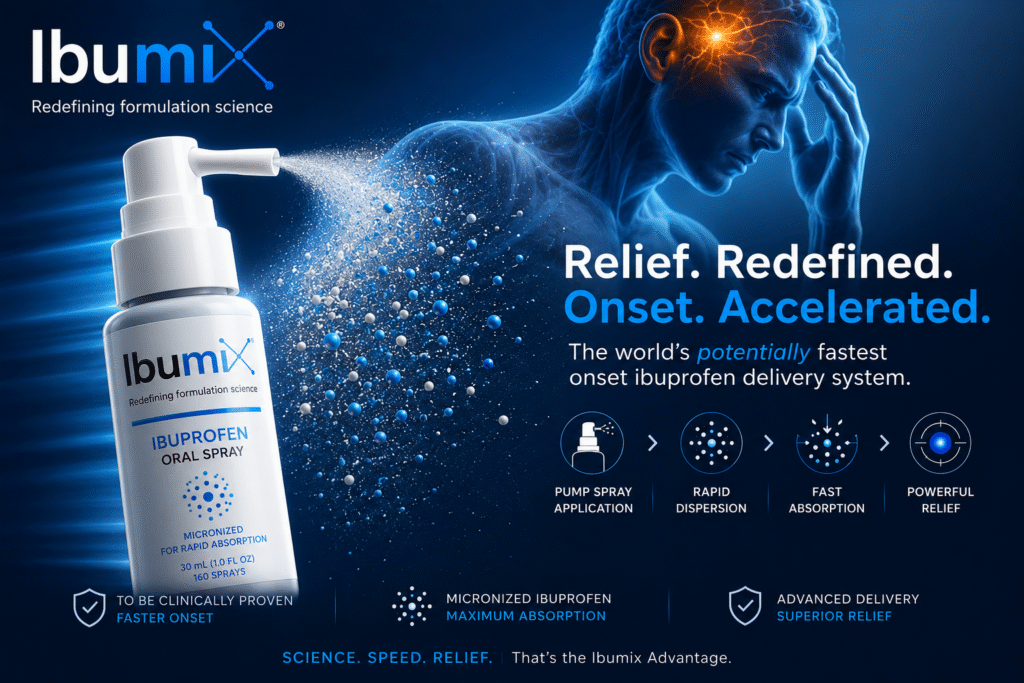
The lead-formulation development target is specific. An all-in-one oral spray ibuprofen — a format with no existing equivalent on the over-the-counter ibuprofen shelf — engineered to bring time-to-onset materially below the 29-to-35-minute floor set by the fastest published ibuprofen formulations to date. On the comparators cited in this article, hitting that target would make the product, on those published numbers, the potentially fastest-onset over-the-counter ibuprofen in the world.
The user experience the chemistry implies: open mouth, one spray, the active is already where the body absorbs it. No tablet to dissolve. No glass of water to find. No thirty-minute wait while the gut decides whether to cooperate that morning. Onset measured in single-digit minutes rather than double-digit hours-of-the-day. The claim is the development target. The proof-of-concept data is yet to be generated.
Potentially the fastest-onset over-the-counter ibuprofen in the world, delivered as the first all-in-one oral spray of its kind. The architectural argument and the product target are the same sentence.
The IP position covers a three-filing UK patent estate over the platform chemistry and the lead formulation routes. Current funding is targeted at the lead-formulation-to-proof-of-concept-to-licensing-conversation envelope, on a programme designed to be the first independent demonstration that ibuprofen’s clinical performance has been left on the table by every conventional tablet on the shelf.
30 minutes. 113 minutes. The numbers have been on the published record since 2019. They are the difference between a child’s fever broken before bedtime and a child’s fever still climbing at midnight. The molecule has not changed in 180 years. The delivery system can change this decade. The science is in. The economics are in. The architecture is in front of us.
Ibuprofen has been waiting since 1843 to arrive on time. The chemistry to make that happen finally exists.
Sources
• February 2026 — Optimizing ibuprofen dosing: insights from in vivo and virtual pharmacokinetic trials — European Journal of Pharmaceutics and Biopharmaceutics — ScienceDirect
• Weiser et al. (2019) — Pharmacokinetics of ibuprofen acid vs ibuprofen lysinate, 400 mg, fasted and fed — Clinical Pharmacology in Drug Development — PMC6767367
• Moore et al. (2014) — Faster, higher, stronger? Evidence for formulation and efficacy for ibuprofen in acute pain — systematic review, 30 studies, 1,015 subjects — ScienceDirect
• Martin et al. (1990) — Pharmacokinetics and absolute bioavailability of ibuprofen from ibuprofen lysine — absolute bioavailability ~100% — PubMed
• Camacho et al. (2024) — Estimating the economic effect of harm associated with high risk prescribing of oral non-steroidal anti-inflammatory drugs in England — The BMJ (doi: 10.1136/bmj-2023-077880) — The BMJ
• Davis & Robson (2016) — The dangers of NSAIDs: look both ways — British Journal of General Practice — BJGP
• Pirmohamed et al. (2004) — ADRs as cause of admission to hospital — 6.5% of admissions, NSAIDs ~30% of ADR class — BMJ
Ibumix is engineering new liquid drug delivery platforms to give existing molecules the clinical performance their label always implied. IP position: a three-filing UK patent estate over the platform chemistry and lead formulation routes. This article is informational and does not constitute medical advice — always follow the dosing instructions accompanying any medicine and consult a qualified healthcare professional where appropriate.
Disclaimer: This article is intended for informational and educational purposes. It does not constitute medical advice. Always follow dosing instructions provided with any medicine and consult a qualified healthcare professional where appropriate.