
Why both small-molecule solubility and biologic stability hit ceilings the surfactant cannot raise — and what an engineered architecture changes.
Polysorbates 20 and 80 sit inside the great majority of marketed liquid biologics and dozens of marketed small-molecule injectables. They are remarkable molecules. They are also being asked to do more than any single molecule can.
· 8-minute read
The pharmacy’s most trusted surfactant
Polysorbate is one of those quiet ingredients that holds modern medicine together. Polysorbates 20 and 80 sit inside the overwhelming majority of marketed therapeutic-protein liquid formulations — antibodies, fusion proteins, recombinant enzymes — and across more than three thousand approved products on the FDA Inactive Ingredient Database. They are written into oral, ophthalmic, topical, parenteral and vaccine-adjuvant routes alike.
They earn that position because they are good at two very different jobs. They solubilise lipophilic small molecules by forming micelles around them. And they shield proteins from the air-water, oil-water and container-surface interfaces that cause aggregation. One molecule. Two jobs. Almost every liquid pharmaceutical container on a hospital shelf depends on at least one of them.
Almost every liquid pharmaceutical container on a hospital shelf depends on at least one of them.
Two problems, two histories
In the small-molecule story, the polysorbate is the vehicle. Docetaxel is formulated in a 50/50 v/v polysorbate 80 / dehydrated alcohol concentrate. Paclitaxel sits in 50% Cremophor EL. Both must be diluted into saline immediately before infusion. As the surfactant concentration falls toward and below the critical micelle level, the drug begins to precipitate from a clear solution into needle-like fibres. The paclitaxel label requires a 0.22 µm in-line membrane filter and non-PVC, non-DEHP tubing as standard practice. Docetaxel and paclitaxel labels both carry severe-hypersensitivity contraindications; published any-grade reaction rates in early paclitaxel cohorts reached around forty-one per cent despite premedication. Surfactant-entrapped free drug makes clearance depend on vehicle concentration in plasma — and the pharmacokinetics turn non-linear.
In the biologics story, the polysorbate is the protector. A therapeutic antibody in solution is a fragile thing. It partially unfolds at any hydrophobic boundary it touches — air, silicone, container surface — and the unfolded protein aggregates. Polysorbate above its critical micelle concentration competes for those interfaces and protects the protein. Until it doesn’t.
Trace host-cell-protein lipases co-purify with the antibody in sub-nanogram-per-milligram quantities. They hydrolyse the polysorbate ester bond. Laurate, palmitate, stearate and oleate are released into the aqueous phase. Their solubility in water at physiological pH is in the low-micromolar range. Above that ceiling they crystallise — one to twenty-five micrometre needles and plates that fail visual and sub-visible particle inspection. A 2026 consortium of fifteen biopharmaceutical companies reported polysorbate loss across twenty-three clinical-stage products. Seven grew fatty-acid sub-visible particles. One grew visible particles. The degradation was predominantly enzymatic.
The stabiliser, in other words, can destabilise — and increasingly often does so within a product’s intended shelf life.
A purer polysorbate is not the answer
It is tempting to conclude that the polysorbate itself is the problem. It is not. The industry has done careful work on polysorbate purity. Super-refined grades have lowered residual peroxides, residual aldehydes and trace metal catalysts that drive oxidative degradation. Those gains are real and have removed one chapter of the failure story.
They do not, however, change the rate at which a lipase hydrolyses an ester bond. A super-refined polysorbate is hydrolysed by lipase at the same rate as a compendial one. Purity addresses the initiation of oxidative degradation. It does not address the consequence of hydrolytic degradation, which is the free fatty acid that crystallises.
And it does not solve the small-molecule problem at all. A purer polysorbate still has the same critical micelle concentration. A diluted infusion concentrate is still a diluted infusion concentrate. The drug still precipitates when the surfactant falls below the level needed to hold it.
Purity is an initiation strategy. The failures that reach the clinic are consequence problems.
The architecture answer
There is a different lever, and it is not at the molecule level. It is at the level of the system the polysorbate sits inside.
If a co-present lipid phase is present in the formulation — finely divided, well-distributed, with a partition coefficient for fatty acids that favours the lipid over water by orders of magnitude — then a free fatty acid released by hydrolysis is absorbed into the lipid before its aqueous concentration reaches the solubility ceiling. The crystal never forms. Anything that keeps that aqueous concentration below the limit prevents the particles, whatever the rate of hydrolysis upstream and whatever enzyme is responsible.
The same lipid phase, in a small-molecule application, carries a much larger payload of lipophilic active than a polysorbate micelle alone. When the formulation is diluted, the system self-emulsifies rather than collapses. This is the same chemistry class that underpins the marketed self-emulsifying drug delivery systems behind Sandimmune Neoral, Norvir and Fortovase. And — for biologics — it is the same architectural principle as MF59 and AS03, the squalene-plus-polysorbate-80 emulsions that have delivered billions of doses of vaccine.
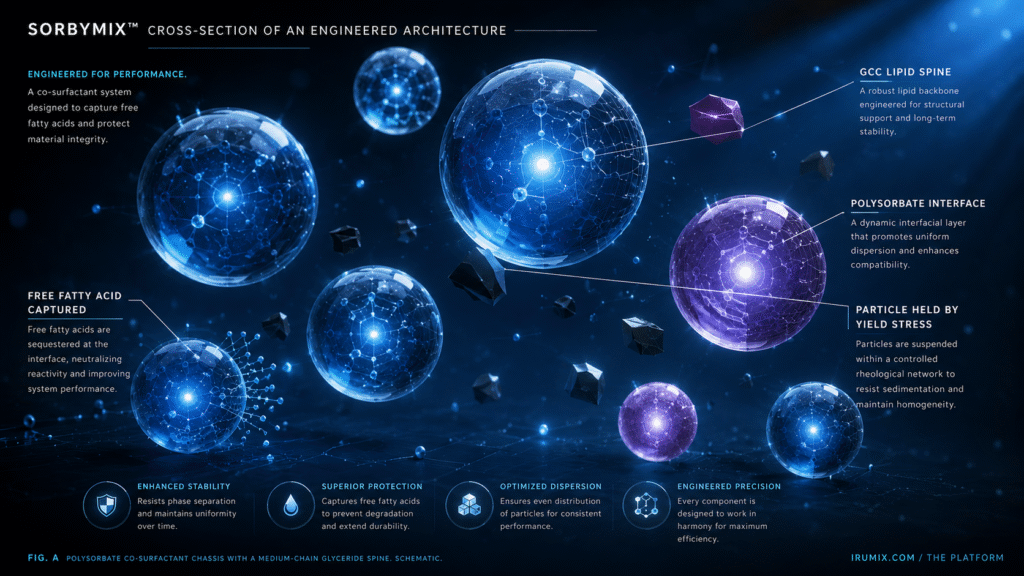
Ibumix calls this chassis family Sorbymix. Each member is one polysorbate — 20, 40, 60 or 80 — co-localised with a pharmaceutical-grade medium-chain glyceride spine of glyceryl caprylate/caprate. The system is approximately eighty-five per cent water: a dilutable concentrate, not a dry or oily excipient. When two or more variants are combined, the ratio is a defined, patented specification — a number on a release sheet rather than a property inherited passively from a feedstock.
It is an architecture strategy, not a purity strategy.
Three mechanisms the molecule alone cannot deliver
The architecture does three things polysorbate cannot do by itself.
- Integral fat sink. The lipid phase captures hydrolysed fatty acid before it can crystallise. For small molecules, it also carries a much larger lipophilic payload than a free polysorbate micelle.
- Tuned interfacial coverage. A mixed Sorbymix system spans C12 laurate to C18:1 oleate. If a lipase preferentially attacks one ester class, the surfactant population shifts rather than collapses. Interfacial protection degrades along a shallow slope, not a cliff.
- Oxidative position. The glyceryl caprylate/caprate spine is fully saturated, with no peroxidation route in the lipid phase. An α-tocopherol option co-localises antioxidant exactly where any lipid peroxide would form. The architecture inherits, rather than competes with, polysorbate purity strategies.
The capability the architecture unlocks: tuneable yield stress
The three mechanisms above fix what polysorbate, on its own, gets wrong. There is a fourth thing the architecture does — and it is not a fix. It is a new capability the molecule alone simply cannot deliver.
A polysorbate-only formulation is Newtonian. It flows like water, and any suspended particle eventually sediments. A structured polysorbate + medium-chain-glyceride system can be engineered to have a finite yield stress. Below that threshold, the system behaves as a soft solid and holds suspended particles in place. Above it — under the shear of a syringe, a dropper, the mouth, the skin — it flows freely. Rheology becomes a designed specification rather than an emergent property.
Internal rheology measurements confirm that yield stress in the Sorbymix system is tuneable across the range required for several format windows that polysorbate-only chemistry cannot reach.
- High-concentration biologic suspensions. Suspended protein particles, crystalline antibodies and amorphous solid dispersions stay homogeneously distributed in the vial indefinitely — and then flow on injection. This is the precedent space of the Yang 2003 crystalline-mAb work and the Bowen 2012 powder-suspension work, brought into a single integrated vehicle.
- Oral suspensions that do not need shaking. The dose-accuracy variability built into ‘shake well before use’ disappears when the suspension is stable at rest. That single change removes one of the largest sources of dosing variance in liquid medicines.
- Topical and transdermal formats that stay on the skin. A finite yield stress holds the system in place under gravity and lets it flow under the shear of finger or applicator. The same property that holds a particle in a vial holds a dose in the right place on the body.
Yield stress is what ‘suspending power’ actually means.
It is also, in a quieter way, what makes Sorbymix a platform rather than a single excipient. Suspending power was already the defining capability claimed for The Mix Platform; tuneable yield stress is what makes that claim a measurable specification on a release sheet rather than a brand line.
Inputs of long precedent, novel architecture
The architecture is novel. The inputs are not. Polysorbates are listed across the FDA Inactive Ingredient Database for oral, ophthalmic, topical and parenteral routes, and are addressed by EMA’s polysorbate excipient guidance. Medium-chain glycerides and pharmaceutical-grade vegetable oils have long parenteral and oral precedent. The construction is engineered; the building blocks are familiar.
That matters for the regulatory pathway. Constructive routes for a system of this design include the FDA Novel Excipient Review Pilot, early engagement with the MHRA Innovation Office, and equivalent EMA dialogue. None of these require a new chemical entity. What is novel is the architecture — and the IP that protects it is twofold: the composition itself, and the methods of use, namely the suppression of free fatty-acid particulation, the engineered rheological signature, and the use of the system as a vehicle for solubilisation, suspension and emulsification.
The polysorbate question has moved
For thirty years, polysorbate was a quiet stabiliser, ordered as a finished excipient and dropped into the formulation late. That phase of the work is over. For some products the polysorbate question has moved from a secondary CMC detail to a developability filter that belongs in candidate selection.
Sorbymix is built for that next chapter. Four standalone chassis — Sorbymix 20, 40, 60, 80 — on The Mix Platform, with one shared family safety dossier and three live UK patent filings underneath. Each is licensable on its own. Combinable when formulation logic supports it. Never required to be.
A purer polysorbate does not fix this. A better interface does.
Ibumix builds the better interface.
Sources
- Wuchner K. et al. (2026) Industry consortium polysorbate stability survey (representative entry — Doshi / Tomlinson lineage). https://pubmed.ncbi.nlm.nih.gov/?term=polysorbate+free+fatty+acid+particles
- Knoch et al. (2020). Polysorbate hydrolysis by host cell proteins — rate independence of polysorbate purity grade. https://pubmed.ncbi.nlm.nih.gov/32418926/
- Doshi N. et al. (2015). Free fatty acid particle formation in polysorbate-containing protein formulations. https://pubmed.ncbi.nlm.nih.gov/26228412/
- Yang M. X. et al. (2003). Crystalline monoclonal antibodies for subcutaneous delivery (PNAS). https://pubmed.ncbi.nlm.nih.gov/12759499/
- Bowen M. et al. (2012). High-concentration monoclonal antibody powder suspensions in non-aqueous vehicles. https://pubmed.ncbi.nlm.nih.gov/22941908/
- FDA Inactive Ingredient Database — polysorbates 20, 40, 60, 80 across all routes. https://www.fda.gov/drugs/drug-approvals-and-databases/inactive-ingredients-database-download
- FDA prescribing information for Taxotere (docetaxel) — 50/50 v/v polysorbate 80 / ethanol concentrate; severe-HSR contraindication. https://www.accessdata.fda.gov/drugsatfda_docs/label/2020/020449s084lbl.pdf
- Taxol (paclitaxel) prescribing information — 0.22 µm in-line filter, non-PVC and non-DEHP tubing requirement. https://www.rxlist.com/taxol-drug.htm
- Weiszhár Z. et al. — Hypersensitivity reactions to taxanes (review). https://pmc.ncbi.nlm.nih.gov/articles/PMC9838553/
- Strickley R. G. (2004) — Solubilizing excipients in marketed oral and injectable formulations. https://www.ncbi.nlm.nih.gov/pmc/articles/PMC2374933/
- O’Hagan D. T. et al. — MF59 adjuvant emulsion (squalene + 0.5% polysorbate 80 + 0.5% Span 85). https://www.frontiersin.org/journals/immunology/articles/10.3389/fimmu.2017.01760/full
- Sigma-Aldrich / Merck white paper — proportion of marketed and pipeline small molecules that are poorly water-soluble. https://www.sigmaaldrich.com/deepweb/assets/sigmaaldrich/marketing/global/documents/363/277/wp8954en-solubility-mk.pdf
Part of the Ibumix series on lipid and liquid-crystal delivery. Start with the overview: Lipid and liquid-crystal drug delivery.