
A Label That Quietly Admits Defeat
A pharmacy refilled a child’s epilepsy suspension from a stock bottle that had not been shaken properly before dispensing.
The manufacturer’s own assay confirmed what happened next: three of the refill bottles came back under-strength. One came back three times over-strength.
Same bottle. Same label. Same four words printed on the side.
Shake well before use.
The child’s seizures came back too.1
The Phrase Every Bottle Carries
It is printed on medicine bottles worldwide, in the same four words, in the same small print.
It reads like guidance. It sounds like reassurance.
It is neither.
It is a workaround for a problem the formulation never solved.
Every “shake well” instruction is a quiet admission: the medicine inside does not stay where it was put. Something in there is falling, and the patient has been handed the job of putting it back.
The Physics No Formulator Can Argue With
Most liquid suspensions exist because the drug will not dissolve. So it is ground fine, dispersed through a liquid, and held there — temporarily — by viscosity and formulation.
Physics does not honour temporary arrangements.
Stokes’ Law describes how a particle settles through a fluid, and it is unsentimental about it: the larger the particle, the denser it is, and the thinner the liquid around it, the faster it falls.6
Look at what modern APIs tend to be: large molecules, dense crystals, poorly soluble by design because solubility was never the property being optimised for.
So they settle. Not eventually. Inevitably.
This Has Been Measured, Not Just Observed
The clearest evidence for any of this isn’t anecdotal. In the late 1990s, the pharmaceutical scientists Deicke and Süverkrüp did something obvious that nobody had done rigorously before: they measured how hard real people actually shake a bottle, rather than assuming a laboratory ideal.2
They recorded the shaking behaviour of 79 people, built a mechanical rig to reproduce it, and calibrated their test method to the 25th percentile of what those people actually did — not vigorous, not careless. Realistic.
Then they bought three commercial erythromycin ethyl succinate suspensions from ordinary community pharmacies and shook each one, at that realistic intensity, three times a day for two weeks — drawing samples by syringe and measuring the actual drug content by HPLC.3
One product performed well. One showed moderate shortcomings. The dose uniformity of the third was, in the authors’ own words, “clearly deficient” — traced to poor wetting of the solid particles. A formulation problem. Not a patient one.
A real product, already on pharmacy shelves, shaken exactly the way real patients shake it, failing to deliver a uniform dose. That is not a hypothetical.
The Illusion of Stability
Formulators call these systems “stable.” On a shelf-life certificate, that word means something specific and modest: acceptable for a defined period, under defined conditions, with a defined instruction attached.
It does not mean the particles stopped moving.
Given time, particles sink. Given more time, they compact into a dense layer at the bottom of the bottle — caking — that resists being redispersed no matter how hard the bottle is shaken.
At that point, “shake well before use” stops being sufficient instruction and starts being false reassurance.
The label does not change to reflect that.
When Shaking Isn’t Enough, the Dose Becomes a Guess
This is where formulation stops being a laboratory problem and becomes a clinical one.
If a suspension is not uniform when the dose is poured, the first doses from the bottle are thinner than the label promises. The last doses are stronger. Not by prescribing error. By sedimentation.
The burden of correcting that — shaking hard enough, for long enough, every single time, for the life of the bottle — shifts from the formulation to the patient. Or, as in the case above, to whoever last handled the bottle in the pharmacy.
For a paediatric anticonvulsant, an anticoagulant, or anything else with a narrow therapeutic window, that shifted burden is not a quality-of-life inconvenience. It is the margin between a therapeutic dose and a subtherapeutic or toxic one.
Give the Industry Its Due
None of this is for lack of trying.
For decades, formulation science has thrown real engineering at the settling problem: raising viscosity so particles fall more slowly, adding surfactants and flocculating agents to keep them loosely clumped rather than densely packed, milling particles smaller, tuning excipients batch after batch.
Every one of those interventions is real pharmaceutical science, and every one of them buys genuine time. They are the reason most suspensions on the market today are dosed safely, most of the time, by most patients, most of whom shake the bottle exactly as well as they were told to.
There is an even sharper version of the steelman buried in the older literature. A 1989 study of phenytoin suspension — a drug where dosing accuracy genuinely matters — found that a well-formulated suspension settled remarkably slowly: no measurable difference between the top and bottom of an undisturbed bottle for five weeks. Minimal agitation was enough to redisperse it fully.4
And clinicians still saw dosing problems with it. The authors’ own conclusion was not settling physics at all — it was “compliance and inaccurate measuring devices.” Patients not shaking consistently. Households measuring “5mL” with whatever spoon was nearest.
Which is the honest version of this argument. Even when a formulator solves the settling problem well enough that it barely matters on paper, the shake-and-measure ritual doesn’t disappear. It just moves the point of failure from the bottle to the kitchen.
But “most of the time, most patients” is precisely the exposure a narrow-therapeutic-index drug cannot carry. And none of those interventions — nor better patient compliance, nor a more accurate spoon — change the underlying fact each was built to manage.
A suspended particle is not a passive object waiting quietly in a liquid. It is a dense solid in a gravitational field, and the liquid around it is not obliged to keep it wherever it was last stirred.
We have spent decades getting extremely good at slowing down a process we never stopped.
A Different Question
At Ibumix, we started from a different premise.
Every approach above answers the same question: how do we keep particles from settling?
We asked a different one instead:
Why does the system need a suspended solid particle in it at all?
Modern formulation chemistry allows something that a milled, dispersed particle never can: a liquid that organises itself. Not a solid held in suspension by force of formulation, but a self-assembling, thermodynamically stable, lyotropic liquid-crystal structure — uniform down to the molecular level, because that is the state it settles into on its own.
No sedimentation. No caking. No reliance on shaking.
Because there is nothing solid left in there to fall.
What “Nothing Left to Fall” Actually Looks Like
Claims like that are easy to make and hard to earn. So here is the demonstration we keep on the lab bench, rather than in a slide deck.
One yardstick first. Most liquid medicines are launched with an initial shelf life of around two years — not because that is where the chemistry runs out, but largely because that is where the regulatory filing does. ICH’s stability guidelines ask for a minimum of twelve months’ real-time data on at least three batches before submission, and — where the data support it and the extrapolation is statistically justified — allow a shelf-life claim to reach roughly 1.5 times the tested duration, capped at no more than six months beyond it.5 Most products are filed on data well short of the shelf life they are eventually granted; many simply launch at 24 months and extend the claim later, once more real-time data exists. Two years, in other words, is usually the earliest defensible number on the label — not the latest a well-designed system could actually reach.
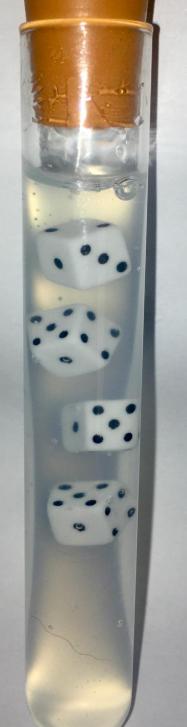
The dice are not the drug. They are 1mm plastic cubes, chosen because they are large, hard, and easy to see — a visible stand-in for the kind of dense, poorly soluble particle a real suspended API would be, at a scale a camera can actually catch settling.
In a conventional suspension, Stokes’ Law gives objects that size and density days, not years, before they are resting on the glass.
These have not moved. Not settled, not caked, not layered — held in a low-viscosity, pourable, sprayable liquid built on Ibumix’s own lipid-based structuring chemistry, sealed and left untouched on a shelf. No shaking, because there was never a moment when shaking would have changed anything.
That is the difference between managing a settling particle and removing the reason it settles.
Two and a half years is six months past that industry starting point, with no formal stability limit driving the number on our side — only the fact that nobody has needed to stop the clock yet.
The Shift Already Under Way
The suspension was never the destination. Like the tablet, it was an intermediate technology — the best available answer at a time when the chemistry to do better did not yet exist.
Expectations have moved on from where that technology was built. Patients expect a dose that behaves the same on day one and day sixty. Regulators expect content uniformity they can actually verify, not uniformity that depends on how vigorously a bottle was shaken in someone’s kitchen. And the chemistry to deliver both now exists.
And yet, in 2026, a meaningful share of the liquid medicines reaching patients still function correctly only if someone shakes them first, for long enough, every time.
Small-molecule NSAIDs were the proving ground here, not the ceiling. Cap-Mix, a separate Ibumix platform in its earliest stage — patent filed, pre-proof-of-concept — is the next chapter — being developed as a bio-enhancer for peptide and protein medicines. It has its own article still to write.
The Quiet Question
If a medicine only works as intended after an intervention by the patient, the pharmacist, or the parent holding the bottle —
was it ever fully designed in the first place?
Ibumix
We are not trying to build a better suspension.
We are trying to remove the reason one was ever needed — designing liquid medicines that are structurally stable, dose-uniform by design, and built around how patients actually use them.
No workarounds. No compromises quietly passed down to the patient.
And, eventually, no instruction printed on the label that exists only to admit what the formulation could not do.
Sources
- 1. Pharmacy Times, “Shake Well Before Dispensing” — reported case of a carbamazepine (Tegretol) oral suspension refill error, in which manufacturer assay found three refill bottles under-strength and one bottle three times over-strength versus the labelled 100mg/5mL concentration: pharmacytimes.com/view/2005-10-9921
- 2. Deicke A, Süverkrüp R. “Dose uniformity and redispersibility of pharmaceutical suspensions. I: Quantification and mechanical modelling of human shaking behaviour.” Eur J Pharm Biopharm. 1999;48(3):225–32: pubmed.ncbi.nlm.nih.gov/10612033
- 3. Deicke A, Süverkrüp R. “Dose uniformity and redispersibility of pharmaceutical suspensions 2: assessment of three commercial erythromycin ethyl succinate oral liquids.” Eur J Pharm Biopharm. 2000;49(1):73–8: pubmed.ncbi.nlm.nih.gov/10613930
- 4. Sarkar MA, Garnett WR, Karnes HT. “The effects of storage and shaking on the settling properties of phenytoin suspension.” Neurology. 1989;39(2 Pt 1):207–9: pubmed.ncbi.nlm.nih.gov/2915790
- 5. ICH Q1A(R2), Stability Testing of New Drug Substances and Products — minimum 12 months’ long-term data on three primary batches at submission: database.ich.org/sites/default/files/Q1A(R2) Guideline.pdf. Extrapolation of shelf life beyond the observed long-term data, where justified, is addressed separately in ICH Q1E, Evaluation of Stability Data — up to 1.5× the tested duration, capped at no more than six months beyond it, under defined conditions: database.ich.org/sites/default/files/Q1E_Guideline.pdf
- 6. Stokes’ Law and its application to pharmaceutical suspension settling velocity is standard pharmaceutics; see any current edition of Aulton’s Pharmaceutics or an equivalent formulation science reference for the full derivation.