
The most powerful molecules in modern medicine share an awkward secret: almost none of them can be swallowed. Cracking that problem is one of the largest unclaimed prizes in pharmaceuticals — and the science is finally moving.
A peptide is a small chain of amino acids — nature’s own signalling language, and the basis of some of the most consequential drugs of the past decade. The GLP-1 medicines reshaping the treatment of diabetes and obesity are peptides. So are insulin, many cancer therapies, and a growing share of the industry’s pipeline. They are exquisitely specific, powerful at tiny doses, and, for the most part, only available as injections.
The reason is deceptively simple. Swallow a peptide and the body treats it not as a medicine but as food. It is denatured by stomach acid, dismantled by digestive enzymes, and then turned away at a gut wall built to keep large, water-loving molecules out. What survives that journey is a rounding error. For most peptides taken by mouth, oral bioavailability — the fraction of the dose that actually reaches the bloodstream — sits below 1%, and often below 0.1%.
The gauntlet and the wall
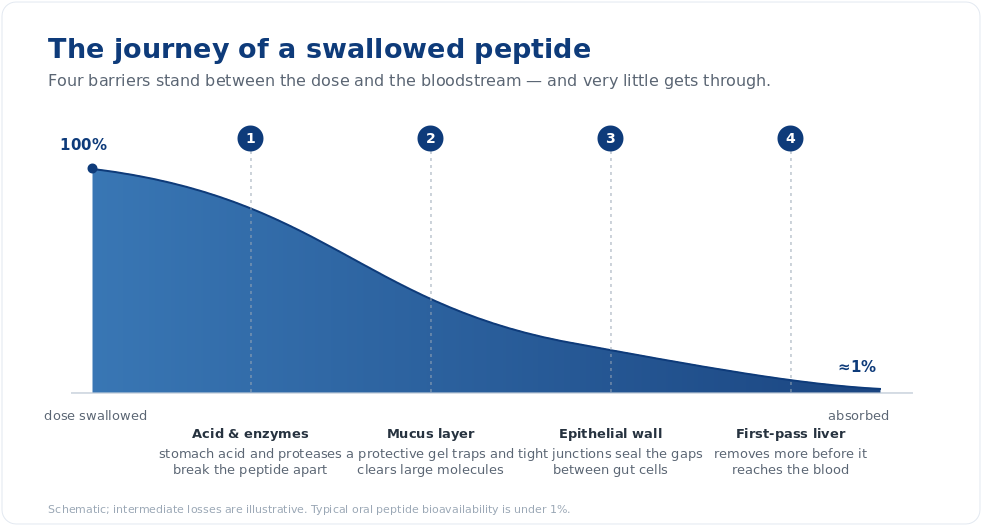
To understand why the number is so low, it helps to follow a peptide on its way down. Four barriers do the damage, in sequence.
The first is chemical. The stomach’s acid unfolds the molecule, and a battery of digestive enzymes — pepsin in the stomach, trypsin, chymotrypsin and others further along — cleaves it into inert fragments. These enzymes exist precisely to take protein apart; a peptide drug is, to them, indistinguishable from a mouthful of dinner. The second is the mucus layer, a thick protective blanket over the gut lining that traps large molecules and sweeps them onward before they can reach the absorbing cells beneath.
The third, and the hardest, is the epithelial wall itself — a single layer of cells engineered to admit small nutrients and exclude almost everything else. Peptides are too large and too water-loving to slip easily through the cells, and the junctions between those cells are stitched shut by protein seals that bar the gaps. The fourth is first-pass metabolism: whatever does get absorbed in the intestine is routed straight to the liver, which strips out more before any of it reaches the circulation.
One detail surprises even seasoned observers: the approved oral GLP-1 is absorbed not in the intestine but in the stomach, in a small protected zone engineered by its formulation. It is a workaround to the gauntlet rather than a defeat of it — and, as the numbers show, a leaky one.
Why size and shape are the real lock
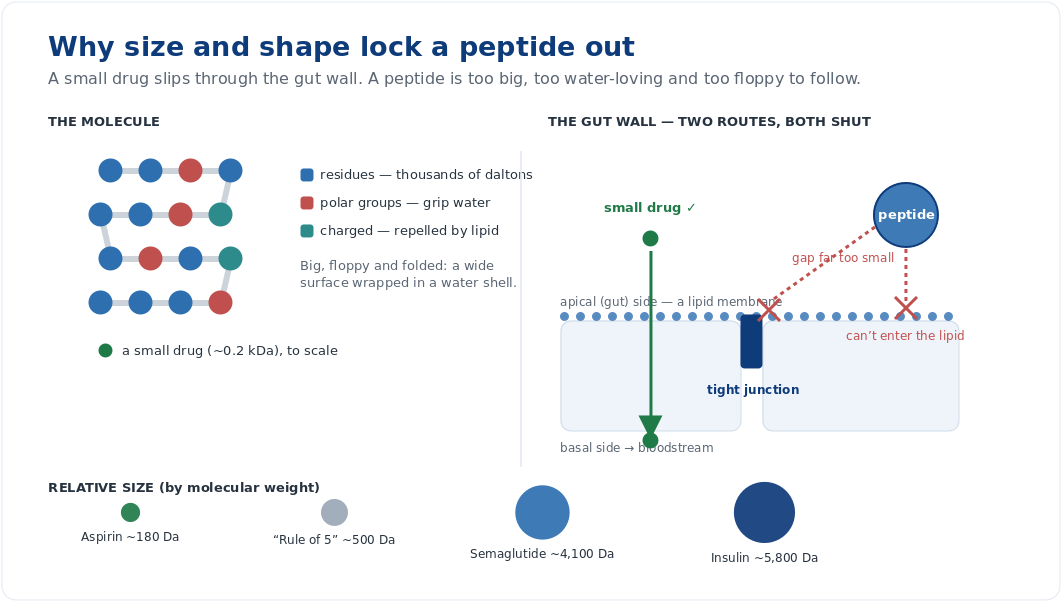
It is worth pausing on why that wall is so hard for a peptide specifically, because the answer is built into what a peptide is. A drug has only two ways across the gut lining. It can pass straight through a cell — but a cell membrane is essentially oil, and to dissolve through it a molecule must be small and reasonably greasy; the classic rule of thumb puts the ceiling near 500 daltons. Or it can squeeze between cells — but those gaps are sealed by tight junctions to a size that passes salts and tiny molecules, not large ones.
A peptide fails both tests at once. Semaglutide weighs around 4,100 daltons and insulin around 5,800 — twenty to thirty times heavier than a conventional oral drug — and both are studded with polar and charged groups that cling to a shell of water they cannot shed to enter oil. The very shape that makes a peptide work, its folded three-dimensional form, is also a broad surface that enzymes can grip and cleave. This is the crux: the problem is inherent, not a formulation oversight. A small molecule can be engineered to slip through; a peptide cannot be shrunk without destroying the shape that makes it a medicine. The molecule cannot change — so the only lever left is to change its environment. That, in a sentence, is the entire field.
The one per cent problem
One per cent is not a footnote. It is the defining constraint of an entire drug class.
Consider the only oral GLP-1 on the market, Novo Nordisk’s semaglutide tablet. It works through a genuinely clever piece of formulation: an absorption enhancer called SNAC creates a small, protected pocket against the stomach lining, raising the local pH to switch off the enzyme pepsin and helping the peptide slip across the gastric wall. It is one of the few oral peptides ever to reach patients — and even so, it delivers only about 1% of the dose. To get there, each tablet carries roughly 300 mg of enhancer to ferry 7–14 mg of drug, and must be taken on an empty stomach with a sip of water and a 30-minute wait before eating.
Update, 6 July 2026: The UK has just become one of the first markets to license this same tablet chemistry specifically for weight loss rather than diabetes. The MHRA approved a higher-dose version — up to 25 mg, well above the 7–14 mg diabetes dose described above — for adults with a BMI of 30+ (or 27+ with a related health condition) on 11 June 2026, and it went on commercial sale from 3 July 2026, priced from £79 through UK online pharmacies [19]. The mechanism has not changed: it is still the same SNAC-enabled route described above, one that has kept oral peptide absorption to a single-digit percentage for years, now carried to a new dose and a new indication rather than a new ceiling — which is exactly the arithmetic this article turns to next.
And that 1% is far from trivial in its effect. In the SOUL trial reported in 2025 — 9,650 patients across 44 countries — oral semaglutide cut the risk of major cardiovascular events (cardiovascular death, heart attack or stroke) by 14% over roughly four years, the first time an oral GLP-1 has shown such a benefit. Even a sliver of absorption, reliably delivered, changes hard clinical outcomes. Which is exactly why the inefficiency is worth solving rather than tolerating.
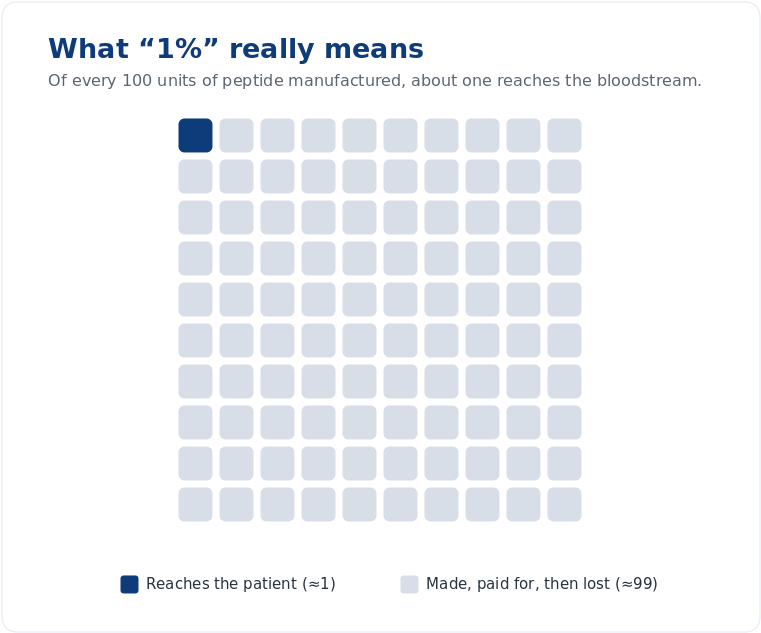
At one per cent bioavailability, a manufacturer must load a hundred units of an expensive, hard-to-make peptide into a pill to deliver one unit of effect. The other ninety-nine are paid for, manufactured, and thrown away inside the patient.
That arithmetic flows straight into cost of goods, dose size, manufacturing scale and price. It is why injections still dominate. And it is why even a modest, reliable improvement — lifting absorption from 1% to, say, 3–5% — would not be a tweak. It would reset the economics of medicines that millions of people take every day.
There is a subtler problem hiding inside the average. When only one per cent is absorbed, small differences between patients — in stomach pH, gut motility, the timing of a meal — translate into large swings in the dose that actually lands. For a delivery technology, raising the average can matter less than taming the variability around it: a medicine that absorbs predictably is a product; one that absorbs erratically is a liability. Control of variance, not just the mean, is what turns an oral peptide into something a clinician can trust.
Why this is the bottleneck of an era
The timing matters, because peptides are in the middle of a renaissance. After decades on the margins, they have become one of the most active frontiers in drug discovery. By GlobalData’s count there are now more than 2,000 peptides in the development pipeline, including hundreds in discovery and preclinical stages. The pace of early clinical work tells the same story: new Phase I peptide trials rose from 18 in 2023 to 72 in 2024 and 137 in 2025 — a 661% increase in two years.
Yet the route of administration has barely moved. The subcutaneous injection still accounts for over 65% of the peptide therapeutics market. Put those two facts together and the shape of the opportunity becomes clear: a surging class of medicines, almost all of it still delivered by needle, gated by a single unsolved problem. The molecule of the moment is stuck in the delivery method of the last century.
The size of the prize
Estimates of the peptide market vary with methodology, but the direction does not. The global peptide therapeutics market is valued by various analysts at somewhere between roughly $50 billion and $130 billion in 2025, with projections toward $200–400 billion by the mid-2030s. The metabolic-disease segment — GLP-1 and its relatives — already makes up well over half of it.
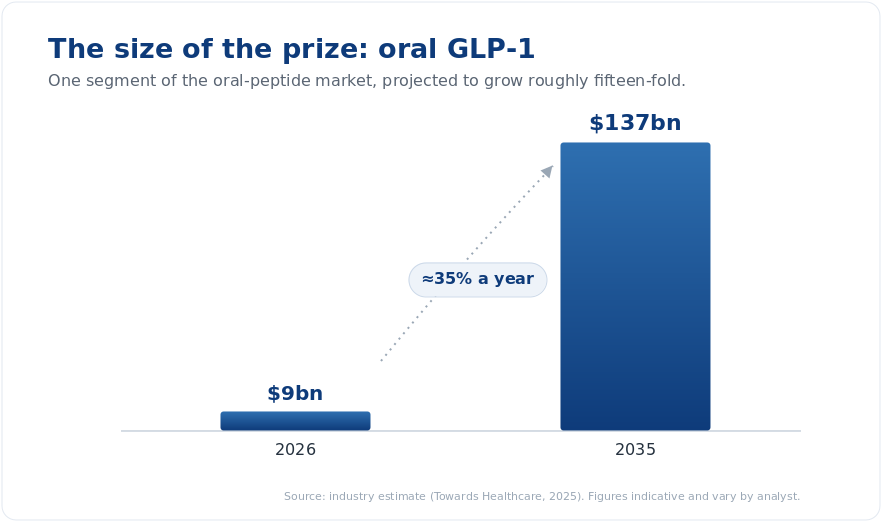
The oral sub-segment is where the growth compounds. The oral GLP-1 market alone is forecast to expand from about $9 billion in 2026 to more than $137 billion by 2035, a compound annual growth rate above 35% — among the steepest of any category in healthcare. The wider GLP-1 market is projected to pass $130 billion by 2035 in its own right.
The bottleneck and the market are the same story told twice. The reason oral peptides are worth hundreds of billions is precisely that they are so hard to make — and the company that makes them reliably easier captures a layer beneath the entire class.
Crucially, the value of solving oral delivery does not belong only to the drug owners. A delivery technology that lifts absorption is an enabling layer: it can be licensed across many molecules and many companies at once. That is what makes it one of the most leveraged problems in the industry.
How it could change medicine, not just markets
The financial case is large. The human case is larger, and it runs along three lines.
The human case begins with scale. By the International Diabetes Federation’s 2025 count, 589 million adults now live with diabetes — more than one in nine — a figure projected to reach 853 million by 2050; over 90% have type 2, and around 252 million remain undiagnosed. Obesity is expected to affect roughly one in five adults worldwide this year. For populations this large, the route of administration is not a convenience but a determinant of whether treatment reaches people at all.
Adherence and the needle barrier. Chronic conditions demand years of dosing, and the injection is a quiet tax on persistence — through needle aversion, technique anxiety and simple fatigue. The desire for an alternative is real but clear-eyed: in one analysis, 77% of patients initially preferred an oral option, a figure that settled to 46% once the strict dosing rules of current oral tablets were explained. The lesson is not that pills always win; it is that a pill without the empty-stomach ritual — a genuinely convenient oral peptide — would expand who starts treatment and who stays on it, particularly in primary care.
Access and the cold chain. This is where oral delivery could be transformative rather than merely convenient. Injectable biologics depend on refrigeration from factory to patient — a cold chain that is expensive, fragile and deeply inequitable. During the recent pandemic, fewer than 2.5% of vaccines produced reached low-income countries, and roughly 19 million doses were discarded in Africa for want of cold-chain infrastructure. A shelf-stable oral biologic sidesteps that entire apparatus. Some analyses estimate an oral biologic could cost as little as 3–5% of its injectable equivalent once fermentation, purification and cold storage are stripped out. For insulin alone — still unaffordable or inaccessible to millions — the implications are profound.
Earlier, broader treatment. Remove the needle and the refrigerator, and a medicine moves from the specialist clinic toward the pharmacy shelf and the family doctor. That changes not just how a drug is taken, but how early and how widely a disease is treated. Yet the field has barely begun: since 2015, only two oral biologic drugs have been approved by the FDA. The gap between what peptides can do and how easily patients can take them remains enormous.
Where the growth is coming from
The geography of demand is shifting. North America still leads on value, but Asia-Pacific is the fastest-growing region, and the oral segment is expected to grow there fastest of all. The drivers are structural: China, where diabetes affects more than 12% of adults and the GLP-1 market is forecast to grow at around 14% a year; India, with a vast diabetic population and a manufacturing base hungry for differentiated products; and Japan, with one of the world’s most established diabetes-prescribing cultures. Asia-Pacific’s GLP-1 market alone was worth around $7.5 billion in 2025 and is climbing quickly.
For these markets, the oral advantage compounds. A medicine that needs no needle, no refrigeration and no specialist administration is not just more pleasant — in much of the world it is the difference between a therapy that reaches people and one that does not.
The state of the art — and the gap that remains
Because no single trick clears all four barriers, the field has fanned out into three broad strategies — change the molecule, change the formulation, or bypass the gut altogether with a device — each with several routes inside it, and almost none yet out of the laboratory.
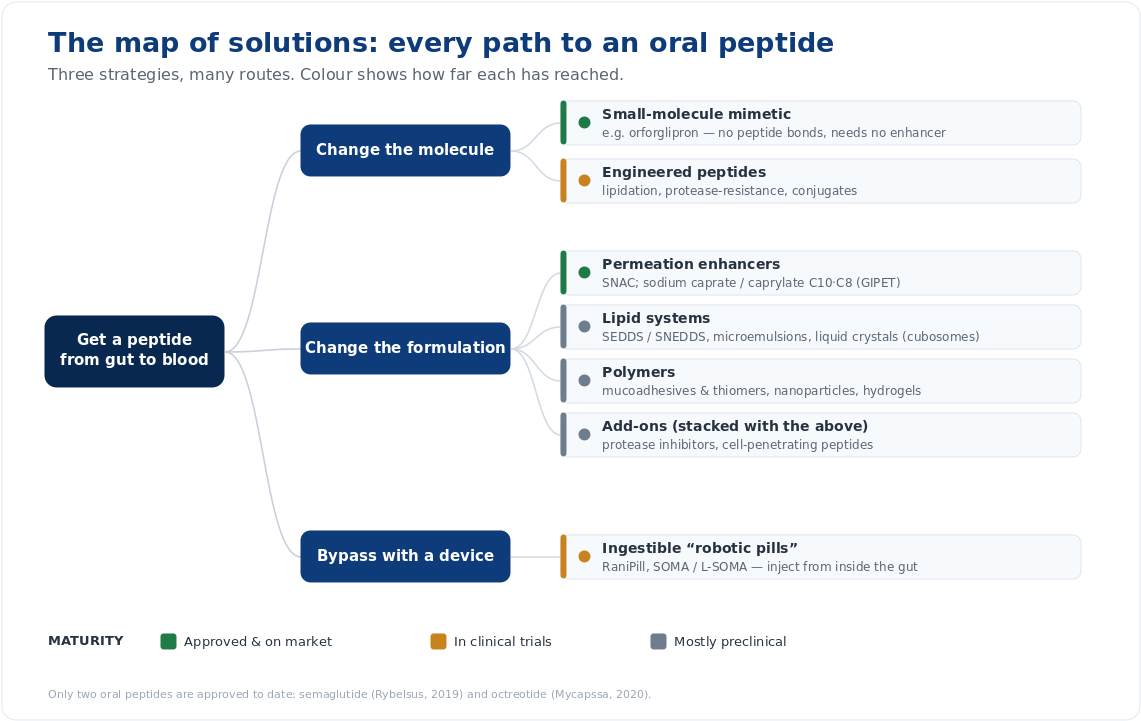
The search for a way in has produced several schools of thought. Permeation enhancers — molecules such as SNAC and the medium-chain fatty acids sodium caprate (C10) and caprylate (C8) — temporarily make the gut a little more permeable. They are the most clinically validated approach, behind both the oral semaglutide tablet and the oral octreotide capsule (Mycapssa). They work, but they tend to plateau near that stubborn 1% and vary from patient to patient.
This enhancer chemistry has a long, well-documented track record. The Gastrointestinal Permeation Enhancement Technology (GIPET), built on medium-chain fatty acids, demonstrated in human studies that it could raise the absorption of difficult molecules such as alendronate, desmopressin and low-molecular-weight heparin — and did so in a way that was rapid, short-lived and reversible, an important safety property. Much of the rigorous academic understanding of how these enhancers actually work, and how far they can be trusted, comes from the group of Professor David Brayden at University College Dublin, whose head-to-head studies of SNAC and sodium caprate have become reference points for the field. By recent counts, around a dozen oral peptide formulations using permeation enhancers are in clinical trials, most of them for insulin and GLP-1 analogues.
There are early signs the 1% ceiling is being lifted. Newer engineered candidates — including oral multi-agonist peptides designed expressly for absorption — have reported absolute oral bioavailability in the region of 4%, several-fold higher than first-generation formulations. Still small in absolute terms, but a reminder that the wall, while formidable, is not immovable.
And the field is crowded with intent. Alongside Novo Nordisk and Eli Lilly, a roster of specialists — among them Oramed, Rani Therapeutics, Entera Bio, Zealand Pharma, Biocon and the lipid-excipient houses — is pursuing the oral route from every angle. The race is on; the finish line is a peptide that crosses the gut as dependably as it works once it is inside.
Most of the formulation effort sits in two families. Lipid systems — self-emulsifying SEDDS and SNEDDS that burst into nanodroplets on contact with gut fluid, and lyotropic structures such as cubosomes — can dissolve a peptide, shield it from enzymes and present it concentrated at the gut wall; several have posted encouraging results in animals. Polymers form the other: mucoadhesive chitosans and thiolated “thiomers” that cling to the lining and briefly loosen its junctions, alongside protective nanoparticles and hydrogels. Both remain largely preclinical — the gut is an unforgiving place for a delicate carrier — but they are where much of the inventive energy now flows.
A second school turns to protein and peptide engineering, redesigning the molecule to resist the enzymes that would destroy it. A third explores physical strategies — nanoparticles, lipid self-assembly, and even ingestible “robotic pills” that inject a dose into the gut wall from inside a capsule — some of which, in animal studies, have reached bioavailability approaching that of a subcutaneous injection, albeit by bringing the complexity of a device to what patients expect to be a simple tablet. Lipid liquid-crystalline systems are a particularly active research seam: in animal studies, insulin protected inside a self-assembled lipid mesophase has reached strikingly high bioavailability, far above what enhancers alone achieve, though such results remain preclinical.
And then there is the disruptor. Lilly’s orforglipron is an oral small molecule that mimics GLP-1 without being a peptide at all — so it has no peptide bonds to protect, needs no enhancer, and in a head-to-head trial outperformed oral semaglutide. Where a small molecule can hit the target, it dodges the absorption problem rather than solving it. But most therapeutic peptides and proteins — insulin, parathyroid hormone, amylin, the multi-agonist peptides now in development — have no small-molecule equivalent. For them, there is still no way in. The delivery problem does not go away; it simply concentrates on the molecules that need the answer most.
Oral isn’t the only answer
Honesty demands a caveat: oral is not the only way to retire the daily injection, and for some patients it is not the best. The opposite bet is to make the injection so infrequent it barely intrudes — a long-acting depot given monthly or quarterly. The clearest example is the lipid-based FluidCrystal depot platform from Sweden’s Camurus, which turns a single injection into a gel that releases drug for weeks; Eli Lilly licensed it in 2025 for long-acting obesity and diabetes therapies in a deal worth up to roughly $870m. So the field is really two opposing strategies aimed at one problem: make the dose convenient enough to swallow, or rare enough to forget. Oral commands the most attention not because it always wins, but because it is at once the format patients most want and the one still least solved.
The unclaimed prize
Step back, and the picture is unusually clear for an industry that rarely offers clean ones. A drug class in the middle of a historic expansion. A market measured in hundreds of billions and growing fastest where the need is greatest. A human upside — in adherence, in access, in equity — that few other advances can match. And a single technical barrier, largely unchanged in decades, standing between all of that and the patient.
The one per cent problem is, in the end, a ninety-nine per cent opportunity. Whoever learns to carry a peptide safely through the gut and reliably across its wall will not have improved a product. They will have unlocked a category — and changed, for a great many people, what it means to take medicine at all.
Published by Ibumix, a UK formulation-science company working on new liquid drug-delivery platforms. This article is general industry and scientific commentary. It is not a financial promotion, nor an offer, invitation or inducement to engage in any investment activity, and it does not constitute investment, medical, legal or regulatory advice. Market figures are third-party estimates and vary by source.
Sources
- Barriers and Strategies for Oral Peptide and Protein Therapeutics Delivery, Pharmaceutics 2025 — mdpi.com/1999-4923/17/4/397
- Current Understanding of SNAC as an Absorption Enhancer, Clinical Diabetes (ADA) 2024 — diabetesjournals.org
- Maher & Brayden et al., Gastrointestinal Permeation Enhancers, Pharmaceuticals 2022 — ncbi.nlm.nih.gov/PMC9781085
- Peptide Therapeutics Market & pipeline (GlobalData; Roots Analysis; ResearchAndMarkets) 2025–26 — rootsanalysis.com
- Oral GLP-1 Market Sizing, Towards Healthcare 2025 — towardshealthcare.com
- GLP-1 Drugs Market to 2035, Towards Healthcare — towardshealthcare.com
- From needles to pills: oral GLP-1 therapy enters the obesity arena, PMC 2025 — ncbi.nlm.nih.gov/PMC12498447
- Ridding the Cold Chain for Biologics, PMC — pmc.ncbi.nlm.nih.gov/PMC7869771
- China GLP-1 Receptor Agonist Market Outlook, Grand View Research — grandviewresearch.com
- Orforglipron, an Oral Small-Molecule GLP-1 Receptor Agonist, NEJM 2025 — nejm.org
- Maher S, Brayden DJ, et al. Intestinal permeation enhancers for oral peptide delivery; and SNAC vs C10 mechanism studies, UCD. — GIPET rationale (PubMed)
- IDF Diabetes Atlas 2025 — global diabetes prevalence. diabetesatlas.org
- SOUL trial: oral semaglutide cardiovascular outcomes, presented ACC 2025. ajmc.com
- Lipid-based oral peptide delivery (SEDDS/SNEDDS; reverse micelles). PMC11468804
- Ingestible devices: robotic pills for GI injection (RaniPill; SOMA). Drug Discovery News
- Chitosan / mucoadhesive polymers for oral insulin. PMC7602211
- Gastrointestinal permeation enhancers beyond SNAC and caprate — what is coming next. PharmaExcipients
- Camurus FluidCrystal; Lilly long-acting incretin licence (2025). FierceBiotech
- MHRA approves the Wegovy pill, the UK’s first weight-loss tablet; UK commercial launch, 3 July 2026. gov.uk